
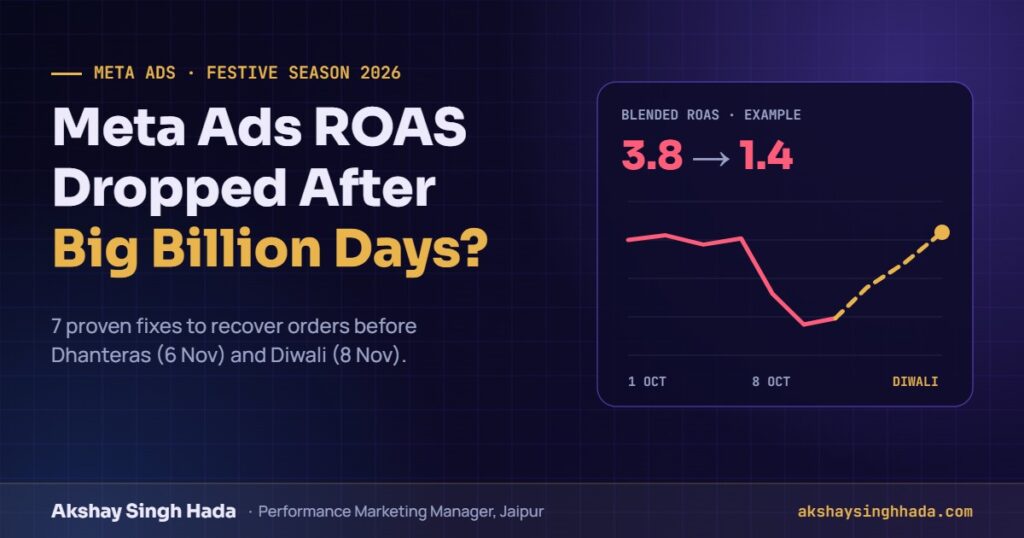
If your Meta ads ROAS has fallen off a cliff since 8 October, you are not imagining it, and your account is probably not broken. Flipkart’s Big Billion Days and Amazon’s Great Indian Festival both opened that week, and for most D2C brands the same budget started buying fewer orders almost overnight.
If that sounds like your account, this guide does three things. It explains what actually changed in the auction, it gives you a five-number equation to find which part of your funnel took the hit, and it lays out seven fixes to run before Dhanteras on Friday, 6 November. I lead paid acquisition for a D2C jewellery launch in India, so the examples lean towards fashion and jewellery, but the logic holds for any brand selling on Meta in the festive window.
Key Takeaways
- A Meta ads ROAS drop in sale week is usually an auction and pricing problem, not a targeting problem. Diagnose before you touch budgets.
- ROAS = CTR × CVR × AOV × 1000 ÷ CPM. Compare 1–7 Oct with 8–14 Oct and the lever that moved tells you the fix.
- Marketplace discounts reset your customer’s price anchor. Answer with value, delivery dates and bundles, not a matching discount.
- Halving the budget kills learning. Cut losing ad sets, protect winners and move spend towards warm audiences.
- Everyone who browsed you during Big Billion Days is now your cheapest Diwali audience. Build those audiences this week.
Table of Contents
What actually happened to your Meta ads ROAS from 8 October
Three things hit at the same time, and most accounts felt all three. Flipkart opened Big Billion Days 2026 with early access on 8 October, and Amazon’s Great Indian Festival started the same day. Every large seller in India went after the same shoppers in the same week.
1. The auction got crowded and expensive
Marketplaces, electronics brands and most of D2C India went live together. Industry estimates put Meta CPMs at roughly ₹80–150 in a normal month and ₹150–300 in peak festive weeks, as this festive performance marketing guide summarises. Your exact number depends on category and audience, but a 50–100% CPM jump in sale week is normal. It is not a sign that something broke.
When CPM doubles and nothing else improves, your Meta ads ROAS halves. That part is pure arithmetic.
2. Your customer’s price anchor moved
For ten days your customer scrolled past 70% off on phones, 60% off on fashion and “lowest price ever” banners. Then your ad showed a ₹1,999 pair of earrings at full price. The product did not change. Her reference point did.
This usually shows up as a conversion rate drop on the website, not as a click-through rate drop. People still click out of curiosity, then compare and leave.
3. Buyers are deferring, not disappearing
A lot of shoppers are waiting for salary credit, for Dhanteras, or for a Diwali offer they assume is coming. Add-to-carts stay healthy while purchases lag. Some of that demand comes back in the first week of November. Some of it went to a marketplace for good.
There is also a reporting effect. With a 7-day click attribution window, purchases that land later get credited back to the date of the click, so mid-week Meta ads ROAS often looks worse than it finally ends up. Do not make big decisions off a single day.
The Meta ads ROAS equation: find the lever that moved
Before you change anything, break ROAS into the five numbers that produce it:
ROAS = CTR × CVR × AOV × 1000 ÷ CPMCTR is link click-through rate, CVR is the purchase conversion rate from link clicks, AOV is average order value and CPM is cost per thousand impressions. Pull all five for two date ranges in Ads Manager, 1–7 October and 8–14 October, with the same attribution setting for both.
Here is an illustrative example with round numbers:
| Lever | 1–7 Oct | 8–14 Oct | Change |
|---|---|---|---|
| CPM | ₹120 | ₹200 | +67% |
| CTR | 1.5% | 1.3% | −13% |
| CVR | 2.0% | 1.4% | −30% |
| AOV | ₹1,500 | ₹1,500 | 0% |
| ROAS | 3.75 | 1.37 | −63% |
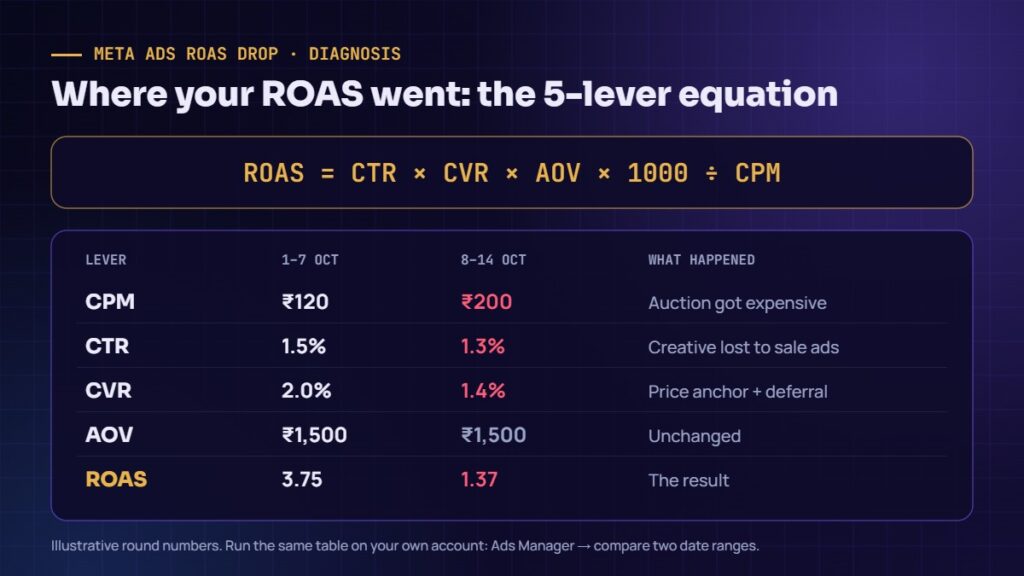
In this example the auction (CPM) and the website (CVR) did most of the damage. Creative (CTR) slipped a little and AOV held. That points to fixes 3, 4 and 6 below, not to a new audience strategy.
Run the same table on your account. It takes ten minutes and it stops you fixing the wrong thing.
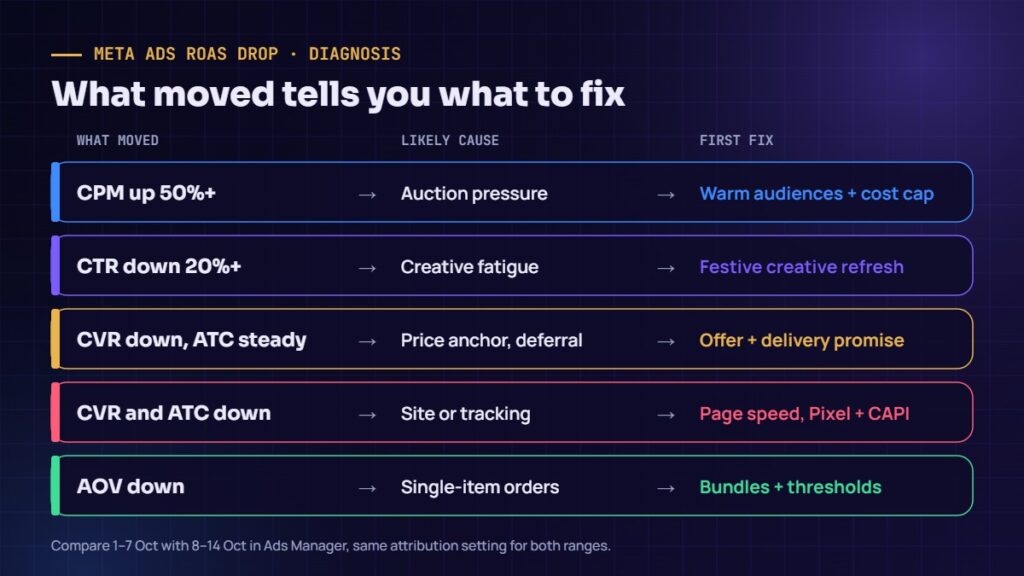
Which cause hit your account? A quick diagnosis
| What moved | Likely cause | First fix |
|---|---|---|
| CPM up 50%+, CTR and CVR steady | Auction pressure | Shift spend to warm audiences, cost cap guardrail |
| CTR down 20%+ | Creative fatigue, or your offer looks weak next to sale ads | Festive creative refresh |
| CVR down, add-to-cart steady | Price anchor or purchase deferral | Offer architecture, delivery promise, retargeting |
| CVR down, add-to-cart down too | Website or tracking issue | Check page speed, checkout, Pixel and CAPI events |
| AOV down | Discount-led, single-item orders | Bundles and spend-threshold offers |
One more check before you blame the market. Open Events Manager and confirm Purchase events from both the browser Pixel and the Conversions API are arriving and deduplicating. Festive traffic spikes break more checkouts and tracking scripts than anyone admits. If purchases in your store and purchases in Meta diverged sharply after 8 October, you have a measurement problem first, and Meta’s Conversions API guide is the place to start.
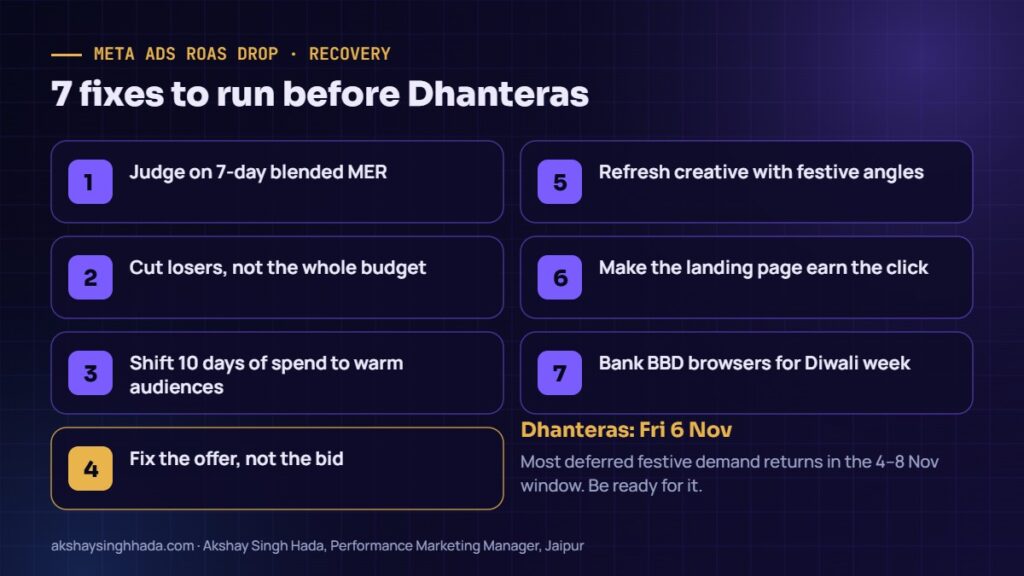
7 fixes for a Meta ads ROAS drop before Diwali
Fix 1: Judge on 7-day blended numbers, not yesterday’s ROAS
Pick one number for decisions this month: blended MER, which is total revenue divided by total ad spend across channels, on a rolling 7-day basis. Platform ROAS during sale weeks swings too much from day to day. If MER is within 15–20% of your September level, most of your Meta ads ROAS dip is attribution timing and auction cost, and the right move is patience, not surgery.
Fix 2: Cut losers, not the whole budget
The panic move is halving the budget across the account. That pushes ad sets back into learning, and Meta’s delivery system needs roughly 50 optimisation events a week per ad set to stabilise. Do this instead:
- Pause ads and ad sets where cost per purchase is above 2x your target after spending at least 2x that target.
- Keep winners at their current budget and stop editing them daily.
- Make budget changes in steps of 20% or less.
- Move the freed budget to retargeting and to your strongest Advantage+ sales campaign.
I go deeper on these rules in the Meta Ads scaling guide, including the frequency thresholds that signal fatigue.
Fix 3: Move spend towards warm audiences for ten days
Cold prospecting carries the worst of the CPM inflation because you are competing for brand-new users with everyone. Warm audiences, meaning website visitors, add-to-carts, Instagram engagers and video viewers from the last 30 days, convert more cheaply because they already know you.
For 15–25 October, a split of roughly 60% prospecting and 40% retargeting is a sensible starting point for a brand that normally runs 80/20. Keep a prospecting floor, though. If you starve prospecting now, your Diwali retargeting pool runs dry exactly when you need it.
Fix 4: Fix the offer, not the bid
You will not win a discount war against a marketplace, so do not start one. Compete on what a marketplace listing cannot easily match:
- A delivery promise: “Order by 3 November, delivered before Dhanteras.” Set the date from your courier’s real SLA, not from hope.
- Gift-ready packaging included, with a message card.
- A spend threshold that lifts AOV: a free gift above ₹2,999, or 2-piece and 3-piece sets priced as bundles.
- A prepaid incentive such as ₹100 off or free express shipping on UPI. It also cuts RTO, which matters more than ROAS for COD-heavy jewellery brands.
- A visible quality reason to pay more: plating thickness, anti-tarnish coating, certification and easy returns.
Put the offer in the first line of primary text and in the first two seconds of video. If it is hidden below the fold of a landing page, as far as the buyer is concerned it does not exist.
Fix 5: Refresh creative with festive angles
Your September creatives were made for a calm auction. Now they run next to sale banners. Build three to five genuinely new concepts rather than colour variants of the same static:
- Price-anchor counter: “Why one ₹1,999 pair outlasts three ₹499 pairs”, with a close-up of the finish and a tarnish test.
- Gifting: “Her Diwali gift, sorted and delivered before Dhanteras.”
- Occasion look: Diwali party styling on a real person, shot as a 9:16 Reel.
- Festive proof: recent reviews and UGC try-ons.
- Deadline: a delivery cut-off countdown in the final week.
Meta’s delivery system reads the creative itself to decide who sees it, so new concepts reach new pockets of buyers. That is how Meta ads ROAS recovers without adding budget. I cover how to produce them quickly in my AI ad creative production workflow.
Fix 6: Make the landing page earn the festive click
If CVR is the lever that fell, the ad is not the problem. Check these on a real mid-range Android phone, not on your laptop:
- Festive offer and delivery date visible without scrolling.
- Page loads in under 3 seconds on 4G.
- Price, offer and shipping cost shown before checkout, not as a surprise at payment.
- Both COD and UPI available, with the prepaid incentive stated clearly.
- Reviews placed next to the Add to Cart button.
My post on five landing page frameworks covers each of these in detail.
Fix 7: Bank the Big Billion Days browsers for Diwali
Everyone who visited, added to cart or engaged between 8 and 14 October and did not buy is now your cheapest Diwali audience. Create these custom audiences today:
- Website visitors from 8 October onwards, excluding purchasers.
- Add to cart in the last 14 days, excluding purchasers.
- Instagram engagers and 50% video viewers from the last 30 days.
- Purchasers from the last 180 days, for a separate repeat-buyer gifting message.
Then show them the Diwali offer in the 4–8 November window. This is where a large share of the deferred demand from sale week comes back, and it is the fastest way to lift Meta ads ROAS when the auction is at its most expensive.
How to read Meta ads ROAS during sale weeks
Meta ads ROAS is a platform number. It only counts purchases Meta can attribute to an ad inside your attribution window, which is why it can disagree with your bank account. In a normal month the gap is stable, so you can steer by it. In sale weeks the gap moves around, and that is exactly when people make bad calls.
Three habits keep you honest:
- Look at Meta ads ROAS and blended MER side by side every morning. If Meta ads ROAS falls but MER holds, credit is shifting between channels; demand is not dying.
- Break Meta ads ROAS down by placement and age band, not only at campaign level. Festive CPM spikes are rarely even, and Reels and Stories often stay cheaper than Feed.
- Separate new-customer revenue from returning-customer revenue. A sale-week dip that sits entirely with returning customers usually means loyal buyers shopped a marketplace for one week, and most of them come back.
If you track only one thing until Diwali, track the 7-day trend of Meta ads ROAS against your break-even ROAS. Above break-even with a falling trend is a creative problem. Below break-even with a flat trend is an offer or margin problem. The fix is different for each, so the distinction matters.
3 mistakes that turn a ROAS dip into a lost Diwali
Switching off Advantage+ campaigns
Advantage+ sales campaigns hold the most conversion data in most accounts. Switching them off resets that learning just before your biggest week. If you must, reduce budget gradually, but keep them live.
Launching twenty new ad sets
Fragmenting the account splits your conversion signal and puts everything into learning at once. Add new creatives to existing winning ad sets or to one fresh testing campaign.
Matching marketplace discounts
A 50% off sale might bring orders back this week and teach your customers to wait for 50% off forever. Protect margin with bundles, thresholds and gifting value instead.
What to expect between now and Diwali
| Window | What usually happens | Your focus |
|---|---|---|
| 15–25 Oct | The first sale wave cools a little | Diagnose, cut losers, launch new creative, build warm audiences |
| 26 Oct–3 Nov | Gifting intent climbs | Scale winners in 20% steps, catalogue retargeting, delivery-deadline creative |
| 4–8 Nov | Dhanteras (Fri 6 Nov) and Diwali (Sun 8 Nov) peak | Retargeting-heavy, cost caps on scale campaigns, last-delivery messaging |
| 9–30 Nov | Costs ease and wedding season starts | Keep winners running, move to wedding and gifting angles |
For the complete phase-by-phase plan with budget percentages, read my Diwali Meta ads strategy for 2026.
Meta ads ROAS drop FAQ
Why did my Meta ads ROAS drop during Big Billion Days?
Mostly because the auction got more expensive and shoppers changed their price expectations. Marketplaces and large brands bid for the same users in the same week, CPMs rose, and full-price D2C products looked expensive next to heavy marketplace discounts. Many buyers also pushed purchases towards Dhanteras and Diwali.
Should I pause Meta ads until Diwali?
No. Pausing resets learning and empties the retargeting pool you will need in the first week of November. Cut losing ad sets, keep winners running at stable budgets and move part of the spend to warm audiences.
How long does a festive Meta ads ROAS drop last?
In most accounts the worst of it lasts through the main sale days. Costs stay high through Diwali week, but conversion rates usually recover closer to Dhanteras as gifting intent peaks. Judge on a rolling 7-day blended number, not on daily platform ROAS.
Is my Meta ads ROAS drop actually a tracking problem?
Check before assuming it is not. Compare purchases in your store backend with Meta-reported purchases for 1 to 7 October and 8 to 14 October. If the gap widened sharply, inspect Pixel and Conversions API purchase events in Events Manager for missing or duplicate events.
Should I give bigger discounts to compete with Flipkart and Amazon?
Usually not. You will not win a discount war against a marketplace, and deep discounts damage margin and train buyers to wait for the next sale. Compete on delivery promise, gift-ready packaging, bundles, spend-threshold gifts and a clear quality reason to pay more.
What Meta ads ROAS should a D2C jewellery brand expect during Diwali?
There is no universal number because margin, AOV and audience warmth differ by brand. Work out your break-even ROAS from contribution margin, stay above it on a 7-day blended basis, and accept a lower platform ROAS on cold prospecting during peak weeks.
The takeaway
A Meta ads ROAS drop in sale week feels like an emergency because the dashboard turns red overnight. Most of the time it is arithmetic: a pricier auction and a customer comparing you with 70% off. Diagnose with the five-lever equation, protect what is working, change the offer instead of the bid, and bank every Big Billion Days browser for Diwali week.
The brands that panic in October usually have the weakest November. The ones that stay calm and prepare tend to own the first week of November.
About the Author
Akshay Singh Hada is a digital performance marketing manager based in Jaipur, Rajasthan, with 7+ years in paid acquisition and ₹1 CR+ in tracked ad spend across Meta Ads and Google Ads for D2C brands and international B2B. Connect on LinkedIn or request an account audit.