
Phone listening is the most persistent myth in marketing, and every marketer in India has had this conversation. A client says they talked about buying a sofa, and an hour later a sofa ad appeared. Proof, they say, that the phone listening theory is real.
I have spent seven years explaining why it is not. As of last month I no longer have to argue, because the US Federal Trade Commission finalised orders against three companies that sold exactly this product — and the reason they were fined is that the product did not work. It was never listening to anyone.

What this covers
- What the FTC found about phone listening ads
- Why the phone listening myth feels so true
- Six real signals, none of them phone listening
- The irony nobody noticed
- If you buy ads, read this part
- FAQ
What the FTC found about phone listening ads
On 21 May 2026 the FTC announced settlements with three companies over a product branded “Active Listening”. On 26 August 2026 it issued the final decision and orders, and announced the finalisation the following day.
The companies were CMG Media Corporation, which does business as Cox Media Group, along with MindSift LLC and 1010 Digital Works LLC. The combined payment is $930,000 — CMG pays $880,000, the other two pay $25,000 each. The money goes to redress for affected CMG customers. The orders bind the companies for twenty years.
Here is what they sold, according to the FTC’s own announcement of the finalised orders: a service that supposedly used a proprietary algorithm to capture conversations picked up by consumers’ smart devices in real time, and then targeted local ads based on what those people had said out loud.
The target buyers were small businesses. Local retailers, service providers, the kind of operator who cannot afford a media agency and desperately wants an edge.
The original May announcement is worth reading alongside the final orders — the FTC laid out the three separate complaints here — and PPC Land covered the twenty-year oversight terms in more detail than most trade coverage bothered with.
What the phone listening product actually was
Email lists. Bought from data brokers, resold at a markup.
No voice data was involved at any point. The FTC also alleged the geographic targeting did not work accurately, and that the companies falsely told buyers consumers had opted into the service when they had not.
Christopher Mufarrige, Director of the FTC’s Bureau of Consumer Protection, put it in one line: being honest with your customers is a basic rule of business, and these companies failed at it.
Sit with the shape of that for a moment. The most famous piece of evidence people cite for the phone listening theory — that a real company was openly selling conversation-based ad targeting — turns out to be the strongest evidence against it. The company selling it could not do it. They were reselling email lists and hoping nobody checked.
Why the phone listening myth feels so true
I want to be fair to people who believe in phone listening, because dismissing them as gullible is both rude and wrong. The experience is real. The explanation is what is wrong.
Three things combine.
You notice the hits and forget the misses. You see roughly a few hundred ads a day across apps. You do not register 297 of them. The one that matches something you said an hour ago burns itself into memory. This is frequency illusion, and it is not a character flaw — it is how attention works.
You and the people around you are the same audience. You talked about the sofa with your spouse, who lives at your address, shares your wifi, and searched for sofas yesterday. Every ad platform can connect a household without hearing a word. The conversation and the ad have a common cause; one did not create the other.
The real systems are genuinely uncanny. This is the part most debunking articles get wrong by over-correcting. Modern ad delivery is extraordinarily good at prediction. When a system is that accurate, an audio explanation feels more plausible than the truth, because the truth sounds like magic.
There is also a simple engineering argument. Continuously transcribing audio from a billion phones would drain batteries visibly, consume enormous bandwidth, and be trivially detectable by any of the thousands of security researchers who pull these apps apart for a living. It is not that it would be evil. It is that it would be expensive, obvious, and worse than the method that already works.
Six things targeting you that are not phone listening
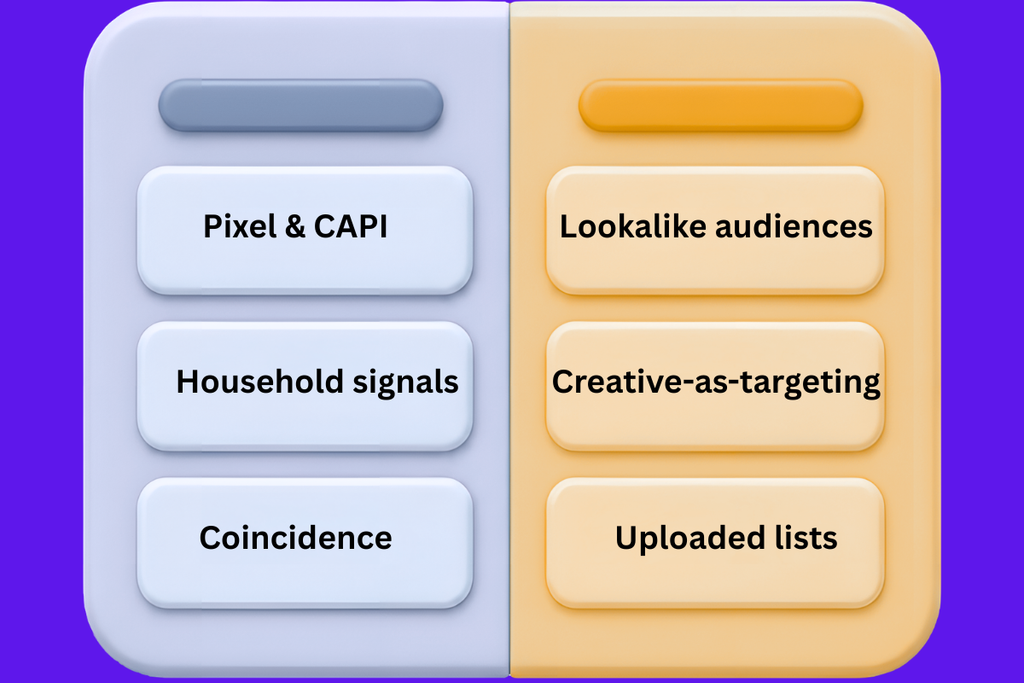
This is the part I can speak to directly, because these are the levers I use every day. Not one of them involves phone listening, and together they explain every uncanny ad you have ever seen.
1. Your own behaviour, measured properly
Every site you visit that runs a tracking pixel reports back. Page views, add-to-carts, purchases, time on page. Server-side tracking through Conversions API sends the same events from the website’s own server, which is why blocking browser cookies alone stopped working years ago.
This single signal explains the large majority of what people attribute to phone listening. You looked at sofas. You forgot you looked at sofas. The system did not.
2. People statistically identical to you
Advertisers upload a list of existing buyers and ask the platform to find more people who resemble them. You may have never touched the brand. You simply pattern-match to four hundred thousand people who did.
3. The creative itself, read by the system
This is the newest mechanism and the least understood outside the industry. Meta’s retrieval layer now analyses the actual content of an ad — the image, the video, the copy — and matches it to individual users, rather than relying on an advertiser-defined audience.
The old question was which audience should see this ad. The system now asks which ad this specific person should see. That inversion produces a lot of the uncanny moments people blame on microphones.
4. Your household and your connections
Shared IP address, shared devices, shared location patterns, overlapping contact lists. If your flatmate researched a holiday, you are a reasonable person to show holiday ads to. No audio required.
5. Data you handed over somewhere else
Loyalty programmes, warranty registrations, that discount code you gave your number for, the app that asked for contacts access. Customer lists get uploaded and matched to platform profiles. This is legal, disclosed in terms nobody reads, and enormously effective.
6. Ordinary coincidence
Sometimes a sofa brand is simply running a broad campaign during a sale week and you are in the age and city bracket. Wedding season, festival season, IPL season. Half of India gets the same ad in the same fortnight, and a few thousand of them happened to mention it out loud that morning.
The irony nobody noticed
While the internet argues about secret microphones, the actual direction of travel is the opposite. Platforms are not quietly adding targeting powers. They are visibly taking targeting controls away from advertisers.
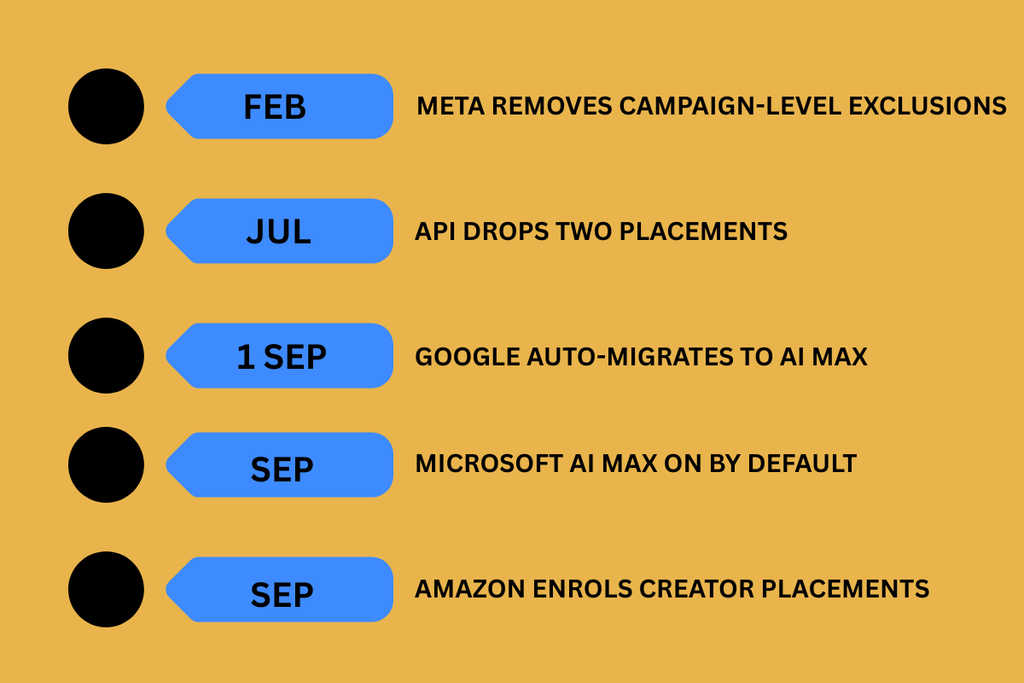
Look at what landed in a single five-week window this year, as Seafoam’s September brief documented:
- Google began automatically migrating legacy Search campaigns to AI Max from 1 September 2026
- Microsoft made its own AI Max generally available and switched it on by default
- Amazon enrolled Sponsored Products campaigns into creator placements without asking
- Meta continued closing off placement exclusions, having already removed campaign-level exclusions in February and dropped Instagram Explore Feed and Messenger Stories as selectable surfaces in the July API release
Meta’s justification is that Advantage+ placements deliver around 11.7% lower cost per action than manual settings. That may well be true on average. The question worth asking is whether your brand is average.
The point for this article is simpler. An industry secretly running phone listening at scale would not be publicly removing the ability to choose where an ad appears. These are the behaviours of a system automating itself, not one hiding a microphone.
And there is a consequence that matters if you run ads. When the levers disappear, the only variables left are your creative, your offer, your audience definition and your landing experience. The platforms just made strategy matter more, not less.
If you buy ads, read this part
The FTC case was not really about privacy. Read the complaint and it is a fraud case, and the victims were small business owners who bought a product that did nothing.
That should worry every Indian brand owner currently being pitched AI-powered marketing services, because the same pitch is circulating here in a dozen variations.
Four questions that kill a fake pitch
Where does the data come from, specifically? Not “our proprietary AI”. A named source. If the answer is vague or the vendor gets defensive, the answer is a data broker list.
Show me the platform this runs on. Real media buying happens inside Meta Ads Manager, Google Ads, LinkedIn Campaign Manager or a named DSP. If nobody will show you the account, there is no account.
Can I see raw platform reporting, not a PDF? A dashboard export with impressions, spend and conversions, from the platform itself. A branded PDF summary proves nothing and takes ten minutes to fabricate.
What consent did these people give? The FTC specifically pinned the companies for claiming consumers had opted in when they had not. If a vendor cannot explain the consent basis, you inherit that problem, not them.
A pitch that cannot survive those four questions is not sophisticated. It is a list.
FAQ
Is my phone listening to me for ads?
There is no credible evidence that mainstream apps transcribe ambient conversations to target advertising, and the one company that openly sold that capability was fined because the product did not exist. What looks like phone listening is almost always your own browsing history, household signals or lookalike modelling.
What was the FTC Active Listening case?
Three companies — Cox Media Group, MindSift and 1010 Digital Works — settled FTC charges over a service marketed as using smart device microphones for ad targeting. The settlement totalled $930,000 and was finalised in August 2026. The service used no voice data; it resold email lists from data brokers.
Why did I see an ad for something I only talked about?
Usually because someone in your household searched for it, you researched it earlier and forgot, you match a lookalike audience of people who bought it, or the brand is running a broad seasonal campaign that reached you anyway.
Can I stop this kind of ad targeting?
You can reduce it. Review ad personalisation settings in your Google and Meta accounts, audit which apps have microphone and contacts permissions, and be more careful about handing over your phone number for discount codes. You cannot remove it entirely while using free ad-supported services.
Does the phone listening myth actually matter for advertisers?
Yes, in two ways. It makes clients distrust legitimate targeting they are already paying for, and it creates a market for vendors selling capabilities that do not exist. Both cost real money.
The takeaway
The phone listening theory survives because the truth is less satisfying than the myth. Nobody wants to hear that they are predictable. A secret microphone is a better story than the fact that you browsed sofas on Tuesday and forgot.
But the FTC has now put a number on it. The only company that openly sold conversation-based targeting paid $930,000 and accepted twenty years of oversight, because the product was email lists with a story attached.
Next time a client tells you their phone is listening, you do not have to argue. Send them the FTC press release.
I am Akshay Singh Hada, a performance marketing manager in Jaipur who has managed ₹1 CR+ in tracked ad spend across Meta and Google Ads. I write about how these systems actually work on the blog — including how Google now reports on content performance beyond your website. If a vendor is pitching you something that sounds too clever, ask me before you sign.