
Google Search Ads still convert better than almost any paid channel for one simple reason: the buyer tells you what they want before you spend a rupee. The problem is that most accounts are not organised around that intent. They are organised around whatever the Recommendations tab suggested last quarter.
Since 1 September 2026, when Google began upgrading Search campaigns that used automatically created assets or campaign-level broad match to AI Max, structure matters more, not less. This is the framework I use for Google Search Ads across D2C and B2B accounts: four campaigns built around buyer intent, a negative keyword system, bidding matched to data volume, and the AI Max controls worth setting on day one.
Key Takeaways
- Organise Google Search Ads by buyer intent first and match type second.
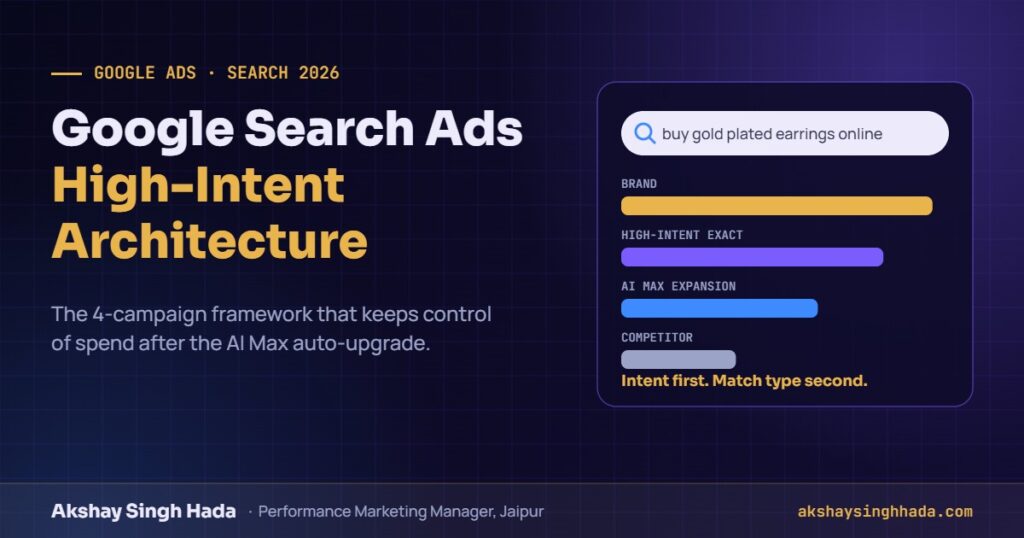
- Four campaigns are enough: Brand, High-intent core, AI Max expansion and an optional Competitor campaign.
- Exact match in Search wins over Performance Max for identical queries. Use that to protect your best terms.
- AI Max is good at finding new queries. Give it its own budget and guardrails instead of letting it run the core.
- Shared negative lists improve ROAS more than most bid strategy changes.
Table of Contents
What changed in 2026: AI Max and why architecture matters
In April, Google said Dynamic Search Ads, automatically created assets and campaign-level broad match would move to AI Max for Search. A later update pushed the Dynamic Search Ads migration to February 2027, while Search campaigns using the other two settings were upgraded from 1 September 2026, as this breakdown of the auto-upgrade explains.
Google says advertisers using the full AI Max feature suite see about 7% more conversions or conversion value at a similar CPA or ROAS, compared with using search term matching alone. That is a real lift for many accounts. It also comes with less control, because AI Max does three things:
- Search term matching serves your ads on queries beyond your keyword list.
- Text customisation writes and adapts ad copy from your site and assets.
- Final URL expansion can send clicks to pages other than the one you chose.
None of that is bad on its own. But if your Google Search Ads account has no clear structure, AI Max will happily spend your budget on loosely related queries and you will not see it until the month-end report. Architecture is how you keep the gains without losing control.
Start with the intent ladder
Before you touch campaigns, sort every query you care about by how close the person is to buying:
| Intent level | D2C jewellery example | B2B export example | Where it belongs |
|---|---|---|---|
| Brand | “[your brand] earrings” | “[your company] wholesale catalogue” | Brand campaign |
| High commercial | “buy gold plated hoop earrings online” | “fashion jewellery manufacturer India wholesale” | High-intent core |
| Comparison | “best demi fine jewellery brands India” | “jewellery sourcing India vs China” | AI Max expansion, carefully |
| Problem or information | “how to stop earrings tarnishing” | “jewellery import duty UK” | Blog and SEO, not Search budget |
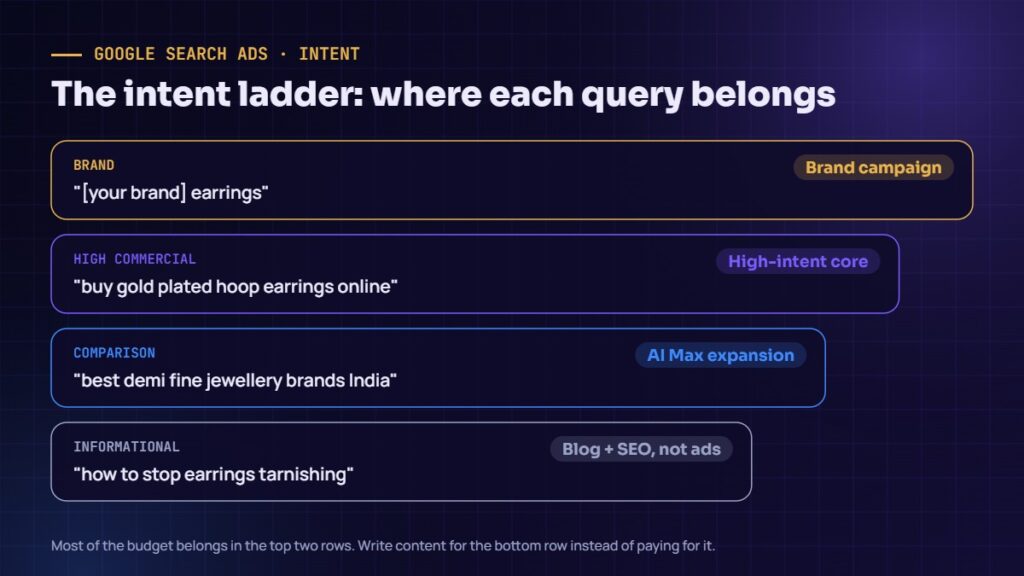
Only the top two rows deserve most of your Google Search Ads budget. The third row can convert, but it needs its own budget and a stricter eye. The fourth row is content territory: write the article, rank for it and retarget the readers instead of paying for every click.
The 4-campaign Google Search Ads structure
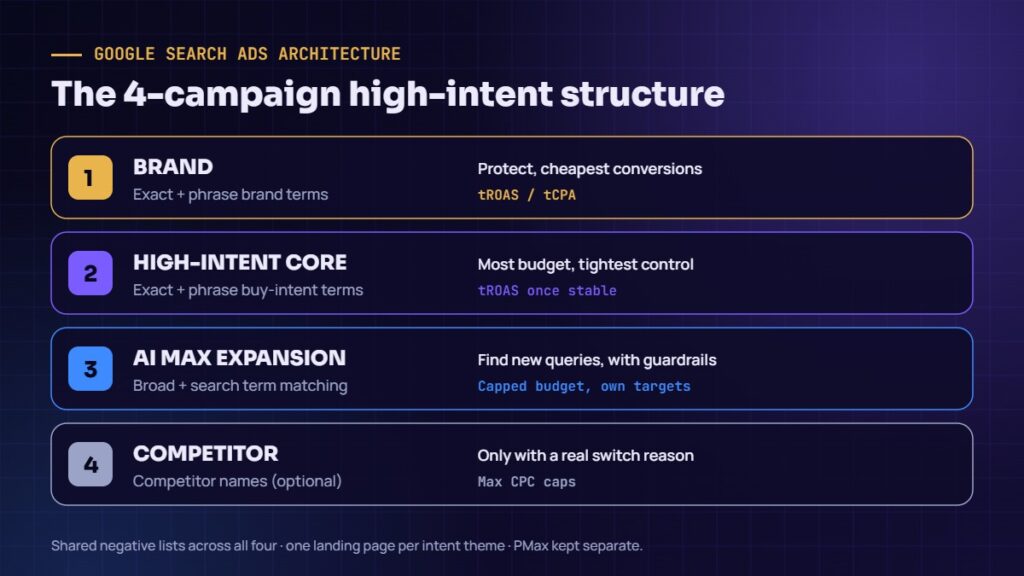
Campaign 1: Brand
Exact and phrase match on your brand name and its common misspellings. Brand clicks are cheap and convert well, and competitors will bid on your name if you leave the space empty. Give brand its own budget so it never competes with non-brand for spend, and report it separately so a strong brand ROAS does not hide weak prospecting.
Campaign 2: High-intent core
This is where most of your non-brand budget should sit, typically 60–70%. Use exact and phrase match on buying queries, in tightly themed ad groups of roughly 5 to 15 keywords each, one theme per product or category. If the same ad and landing page would not suit every keyword in a group, split the group.
For this Google Search Ads campaign, write responsive search ads with the keyword theme in a headline pinned to position one, and your offer or proof point available for position two. Send each ad group to the page that matches it, not to the homepage.
Campaign 3: AI Max expansion
Broad match with search term matching switched on, given 15–25% of non-brand budget and its own targets. This campaign exists to find queries you have not thought of. Every week, move the converting search terms it finds into the core campaign as exact match, and add the junk to your negative lists.
Set the AI Max controls before you launch: brand inclusions or exclusions, URL exclusions for pages that should never receive paid traffic, and text guidelines so generated copy stays on brand.
Campaign 4: Competitor (optional)
In Google Search Ads, bid on competitor names only when you have a real reason for someone to switch, such as a better warranty, faster delivery or lower minimum order quantity. Keep CPCs capped, send traffic to a page that makes the comparison honestly, and do not use competitor trademarks in ad text.
Search vs Performance Max: which campaign gets the query?
This is the rule most accounts never use deliberately. According to Google’s help page on how Performance Max interacts with other campaigns, when a search query is identical to an exact match keyword in a Search campaign, or a spell-corrected version of it, the Search campaign is preferred over Performance Max. For other queries, Ad Rank decides.
So put your highest-value buying queries into the core campaign as exact match. That keeps them inside Google Search Ads, where you control the copy, the landing page and the bid, while Performance Max works on Shopping, YouTube and discovery inventory. Add your brand terms as exclusions in Performance Max if you want brand traffic reported cleanly in Search.
Build a negative keyword system, not a list
In Google Search Ads, negatives decide what you do not pay for, and they do more for ROAS than most bid strategy changes. Use shared lists so one update applies everywhere:
| Shared list | Example terms | Apply to |
|---|---|---|
| Freebies and DIY | free, diy, how to make, tutorial | All non-brand campaigns |
| Jobs | job, career, salary, hiring | All campaigns |
| Wrong material or tier | real gold, 22k, real diamond (for a demi-fine brand) | Core and expansion |
| Wholesale terms | wholesale, bulk, supplier, manufacturer | D2C campaigns only |
| Retail terms | single piece, near me, buy one | B2B campaigns only |
| Marketplaces | amazon, flipkart, meesho | Core, unless you choose to target them |
Notice that the wholesale list is a negative for D2C and a target for B2B. One account can serve both, but only if the lists are built on purpose. Google’s guide to keyword matching options explains how each match type treats negatives differently.
Ads and landing pages that match intent
- Write 15 headlines per responsive search ad, including the keyword theme, the offer, a proof point and a delivery or MOQ promise.
- Pin one keyword headline to position one where message match matters; leave the rest unpinned so Google can test.
- Use sitelinks, callouts, structured snippets and price assets. They increase ad size and click-through rate at no extra cost per click.
- If text customisation is on, add text guidelines and review generated assets weekly.
- Send each ad group to a matching page: a filtered category page for D2C, a catalogue plus request-for-quote form for B2B.
Structure gets Google Search Ads the right query; the page decides whether that high-intent click becomes revenue. My five landing page frameworks cover message match, speed and form friction in detail.
Bidding that matches your data volume
| Conversions per campaign per month | Bid strategy | Why |
|---|---|---|
| Under 15 | Maximise clicks with a CPC cap, or Maximise conversions | Not enough data for targets yet |
| 15–30 | Maximise conversions without a target | Let the system learn first |
| 30–50 | Target CPA, set near your actual CPA | Enough data to steer |
| 50+ with reliable values | Target ROAS, set 10–20% below current ROAS | Room to scale without choking delivery |
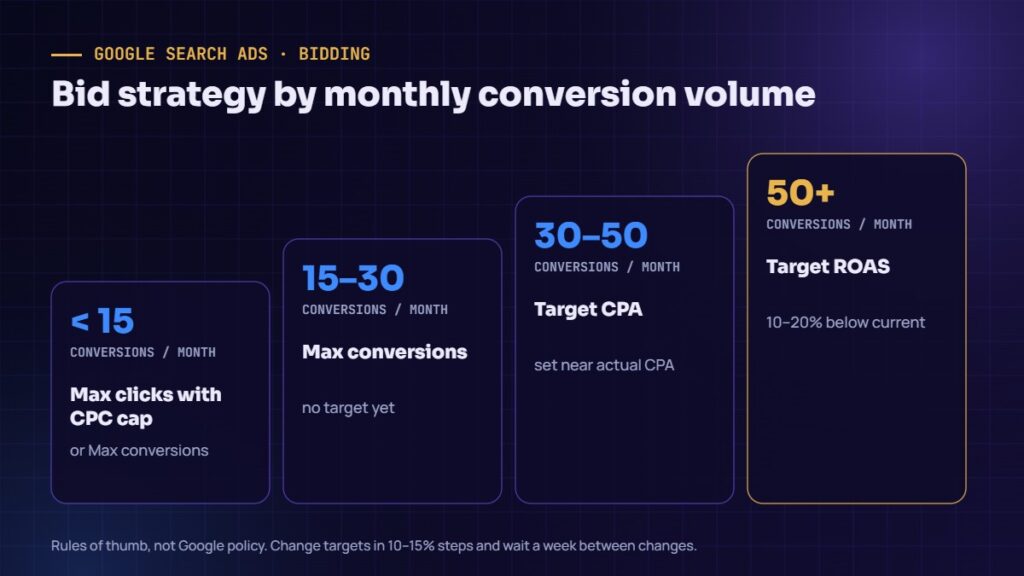
These thresholds are rules of thumb, not Google policy, but they stop the most common Google Search Ads mistake: setting an aggressive target on a campaign that has twelve conversions a month and wondering why spend stops. Change targets in steps of 10–15% and wait at least a week between changes.
Measurement: what Google Search Ads should optimise for
- Turn on enhanced conversions so purchases and leads match back more reliably.
- For D2C, pass real order values, ideally net of discounts, so ROAS bidding works with real numbers.
- For B2B, import offline conversions from your CRM for qualified leads and closed deals. Optimising Google Search Ads to raw form fills fills your sales team’s calendar with tyre-kickers.
- Keep one primary conversion per goal and mark the rest as secondary.
- Report brand and non-brand separately, every time.
Google Search Ads for B2B exporters
If you sell to wholesale buyers in the US, UK, Australia or Europe, volumes are small and sales cycles are long. A few adjustments make Google Search Ads work in that setting:
- Target by country and schedule ads to the buyer’s business hours, not yours.
- Use supplier, manufacturer, private label and MOQ terms; avoid retail language completely.
- Ask for business email, company website and expected order volume in the form to filter out retail shoppers.
- Import qualified-lead and deal stages as offline conversions so bidding learns what a real buyer looks like.
Search captures buyers who are already looking. Pair it with LinkedIn for buyers who are not searching yet, and with organic content that answers the questions procurement teams ask before they shortlist suppliers.
AI Max controls checklist
If any of your Google Search Ads campaigns were upgraded on 1 September, open each one and check these settings. Defaults are rarely what a brand would choose on purpose.
- Which AI Max features are on: search term matching, text customisation and final URL expansion, one by one.
- Brand controls: include your own brand where relevant and exclude brands you do not want to appear for.
- URL exclusions for careers, blog, policy and out-of-stock pages that should never receive paid clicks.
- Text guidelines covering words, claims and tone the generated copy must avoid.
- Pinned headlines for anything legally or commercially critical, such as prices, warranties and delivery promises.
- A weekly look at the search terms report, with AI Max matches reviewed separately from keyword matches.
Where you can, test AI Max as an experiment against your current setup instead of switching everything at once. A clean comparison over two to four weeks tells you more than any average lift figure.
5 Google Search Ads architecture mistakes
1. One campaign that does everything
Brand, generic, competitor and research queries in one campaign share a single budget and a single bid target. The cheapest clicks win the budget and the reporting turns meaningless.
2. Hiding brand inside non-brand
Brand queries convert at many times the rate of generic ones. Mixed together, they make weak non-brand Google Search Ads look profitable right up until a competitor starts bidding on your name.
3. Broad match in the core with no negatives
Broad match is a discovery tool. Put it in the expansion campaign with strict lists, not in the campaign that carries most of your budget.
4. Sending every click to the homepage
A buyer searching for a specific product should land on that product or category. The homepage makes them search again, and most will not.
5. Optimising B2B campaigns to every form fill
If a student enquiry counts the same as a container order, bidding will chase the cheap one. Feed qualified-lead data back into Google Search Ads so the system learns the difference.
The weekly Google Search Ads routine
- Monday: review search terms in every campaign, add negatives at list level, and move converting expansion queries into the core as exact match.
- Tuesday: check impression share lost to budget versus lost to rank. Budget-limited winners get more money; rank-limited ones need better ads or pages.
- Wednesday: review responsive search ad assets and replace the weakest headlines.
- Thursday: compare landing page conversion rates by ad group and fix the worst page.
- Monthly: review the structure itself and merge or split ad groups as volume changes.
If you also track how your brand shows up in organic search, my guide to Search Console platform properties shows how to bring social content performance into the same view.
Google Search Ads FAQ
What is a high-intent Google Search Ads campaign?
It is a Search campaign built only around queries where the person is close to buying, such as product plus “buy”, “price” or “online”, or supplier and wholesale terms for B2B. It uses exact and phrase match, tightly themed ad groups and a landing page that matches each theme.
Should I use broad match in Google Search Ads in 2026?
Yes, but in its own campaign with its own budget and guardrails. Broad match and AI Max search term matching are good at finding new queries. Keep your proven buying queries as exact match in a separate core campaign so expansion never takes over your best traffic.
Does Performance Max take traffic from my Search campaigns?
Not for identical queries. Google states that when a search matches an exact match keyword in a Search campaign, or a spell-corrected version of it, the Search campaign is preferred over Performance Max. For other queries, Ad Rank decides which campaign serves.
How many keywords should a Google Search Ads ad group have?
Enough to cover one tight theme, usually somewhere between 5 and 15 closely related keywords. If the same ad and landing page would not suit every keyword in the group, split it.
Can I opt out of the AI Max upgrade?
Campaigns were upgraded because they had automatically created assets or campaign-level broad match switched on. Turning those settings off before the upgrade avoided it. After the upgrade, review which AI Max features are active and set brand, URL and text controls rather than leaving defaults.
How much budget should go to brand campaigns?
Only what it takes to cover brand search demand at a high impression share. Brand clicks are cheap and usually convert well, but report brand separately so it does not hide weak non-brand performance.
The takeaway
Google keeps automating more of Search, and that is fine. Automation is good at finding queries and writing variations. It is not good at knowing which queries make you money and which ones only look relevant. That knowledge lives in your structure.
Build Google Search Ads around intent, protect your best terms with exact match, give AI Max a sandbox with clear walls, and keep your negative lists tidy every week. The account will get simpler to run and more profitable at the same time.
About the Author
Akshay Singh Hada is a digital performance marketing manager based in Jaipur, Rajasthan, with 7+ years in paid acquisition and ₹1 CR+ in tracked ad spend across Meta Ads and Google Ads for D2C brands and international B2B. Connect on LinkedIn or request an account audit.