
Performance marketing in 2026 is no longer about outsmarting the algorithm through complex interest clusters or hidden targeting hacks. Meta Ads scaling today depends entirely on consolidation, historical data accumulation, and creative resonance. Having managed over ₹1 CR in tracked ad spend across competitive D2C and B2B verticals, I have watched countless ad accounts crumble under the weight of outdated media buying strategies.
Meta Ads 2026: My ₹1 CR+ Ad Spend Framework
The transition from a stable budget to an aggressive scaling model requires a structural shift in how you view data, budgets, and creative pipelines. If you attempt to scale a broken media architecture by simply pushing more capital into it, the algorithm will reward you with soaring customer acquisition costs (CAC) and broken margins. This guide details the exact operational frameworks I use to scale accounts predictably without destroying the return on ad spend (ROAS).
Table of Contents
- Why Most Accounts Stop at ₹3 Lakh
- What Meta Ads Scaling Actually Means
- The 3-Tier Campaign Architecture
- Advantage+ Sales Campaigns (formerly ASC)
- Audience Fatigue Math
- Creative Refresh Velocity
- Budget Distribution
- 5 Most Expensive Mistakes
- FAQ
Key Takeaways
- Consolidation Wins: Consolidating multiple lookalike and interest ad sets into a single broad campaign reduces the learning phase duration by up to 40 percent.
- The 2.5 Frequency Rule: When your 7-day frequency metric hits a 2.5 threshold at the top of the funnel, ad fatigue is actively suppressing your conversion efficiency.
- The 30 Percent Creative Rule: At scale, you must introduce a minimum of 30 percent new creative variants every single week to prevent performance decay.
- ASC Guardrails: Always apply a strict 5 to 10 percent budget cap on existing customers inside Advantage+ Shopping Campaigns to protect profit margins.
- Unit Economics over ROAS: Focus your scaling decisions on the overall Marketing Efficiency Ratio (MER) rather than relying solely on platform-reported ROAS.
- Testing vs Scaling Split: Allocate a dedicated 20 percent of your total daily budget to iterative creative testing, keeping it strictly separate from scaling campaigns.
Why Most Meta Ads Accounts Stop Scaling at ₹3 Lakh Per Month
The ₹3 Lakh per month barrier is the most common ceiling for growing brands in India. Up to this point, an ad account can survive on low-hanging fruit, meaning small lookalike segments, highly specific interest groups, and warm retargeting audiences. The native pixel data can easily find a few dozen buyers a day within these tightly defined pockets.
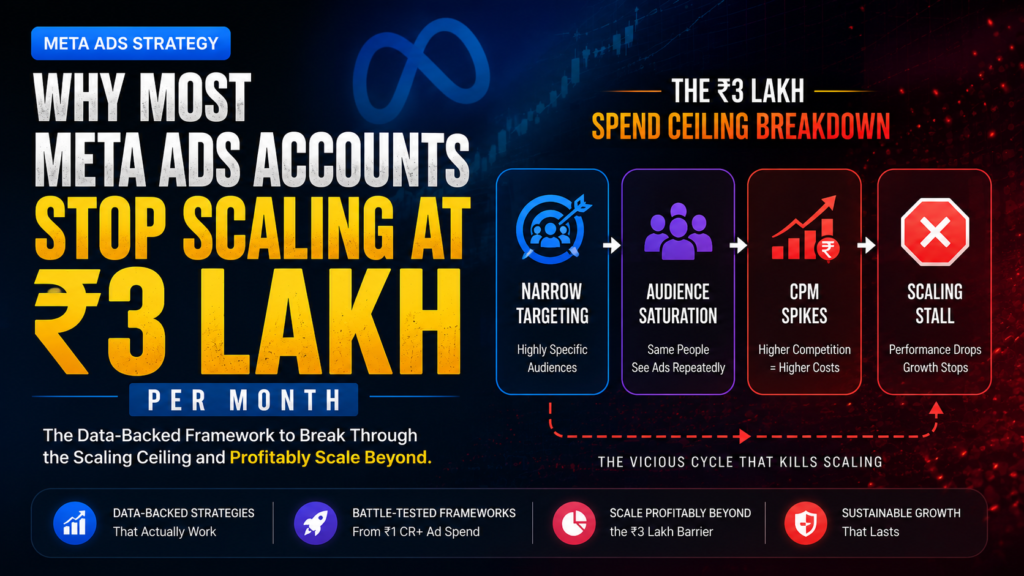
However, as soon as you attempt to push past this budget level, your core audiences saturate rapidly. The auction dynamics change completely when your daily budget demands a higher volume of impressions. Meta is forced to bid more aggressively to win placements within your narrow targeting pools, which drives up your Cost Per Mille (CPM) and Cost Per Click (CPC).
Another primary reason for this stagnation is structural ad account fragmentation. When an account contains five different campaigns targeting similar demographics, those campaigns actively bid against each other in the auction. This internal competition increases your costs and dilutes your data pool, making it impossible for any single ad set to exit the platform’s critical learning phase.
What Meta Ads Scaling Actually Means (And Why Most People Get It Wrong)
Most media buyers define scaling as the simple act of increasing the daily budget on a winning ad set. They find an ad set that delivers a 4.0 ROAS, double the budget, and are shocked when the ROAS plummets to 1.5 the very next day. This is a fundamental misunderstanding of platform liquidity and marginal return dynamics.
Real scaling is the systematic expansion of your addressable market while maintaining sustainable unit economics. When you increase spend, you are buying lower-intent impressions further down the demographic pool. Therefore, scaling requires your creative assets to work harder to convert colder traffic.
Instead of tracking platform-reported ROAS in isolation, scaling requires you to focus on the Marketing Efficiency Ratio (MER). You must calculate your total revenue divided by your total ad spend across all channels. If your platform ROAS drops slightly but your overall business net profit increases due to higher order volume, your scaling strategy is working perfectly.
The 3-Tier Campaign Architecture
To manage high budgets predictably, I organize every ad account into a strict three-tier campaign architecture. This structure ensures that your testing processes never disrupt your stabilized scaling budgets.
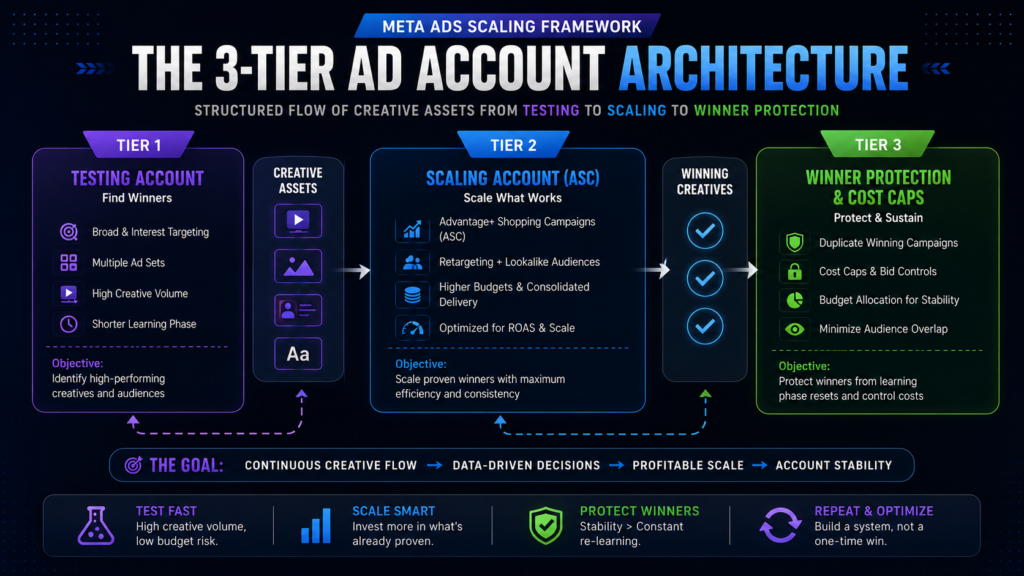
Tier 1: The Creative Testing Engine
This is an Advantage+ Budget Optimization (CBO) or Ad Set Budget Optimization (ABO) campaign dedicated entirely to finding new creative hooks. I use broad targeting (completely open age and gender with no interests) and test 3 to 5 creative variations at a time. Each test group runs with a specific, controlled budget to ensure fair delivery.
Tier 2: The Main Scaling Asset
This tier consists of your consolidated scaling campaigns, which generally leverage Advantage+ Shopping Campaigns (ASC) or a clean, broad CBO campaign. Only creative assets that have proven their efficiency by winning budget and maintaining a low cost-per-acquisition in Tier 1 are graduated into this campaign.
Tier 3: Winner Protection and Guardrails
For accounts spending over ₹50,000 a day, I introduce a manual campaign running strictly on Cost Cap or Bid Cap rules. This campaign acts as a safety valve. When auction costs spike globally, the scaling campaigns might experience margin compression, but the Cost Cap campaign will only spend when conversions are available at your exact target cost.
Advantage+ Sales Campaigns (formerly ASC): When to Switch, When to Hold Back
Meta has since renamed Advantage+ Shopping Campaigns to Advantage+ sales campaigns, but the mechanics below are unchanged and most media buyers still call it ASC. Advantage+ Shopping Campaigns (ASC) represent Meta’s most powerful automation layer. By combining targeting, placement, and creative optimization into a single machine-learning loop, ASC can drive massive volume. However, relying on it blindly can introduce severe margin risks.
The biggest trap inside ASC is existing customer inflation. If you do not configure your account settings correctly, Meta will naturally optimize for the easiest conversions. The system will serve your scaling ads to people who have already bought from you multiple times, showing an inflated platform ROAS while driving zero incremental brand growth.
Before scaling an ASC campaign, you must go into your account settings, define your existing customer list via custom audiences, and set an explicit existing customer budget cap. I recommend keeping this cap between 5 and 10 percent. If your product lineup lacks structural depth or your brand is launching a single hero product, hold back on ASC and use a manual broad CBO campaign instead to maintain control over your asset distribution.
Audience Fatigue: the frequency math (2.5 / 3.0 / 4.0 thresholds)
Audience fatigue is not an abstract concept, it is a mathematical certainty tied directly to your frequency metrics. In the ad accounts I have managed, I track the 7-day and 30-day frequency metrics inside the breakdown tabs very closely.
When your top-of-funnel campaign frequency hits a 2.5 threshold over a rolling 7-day period, it means the average user in your target pool has seen your ad two and a half times. At this exact point, you will usually notice an upward trend in your CPA. The initial pool of highly responsive buyers has exhausted its immediate intent.
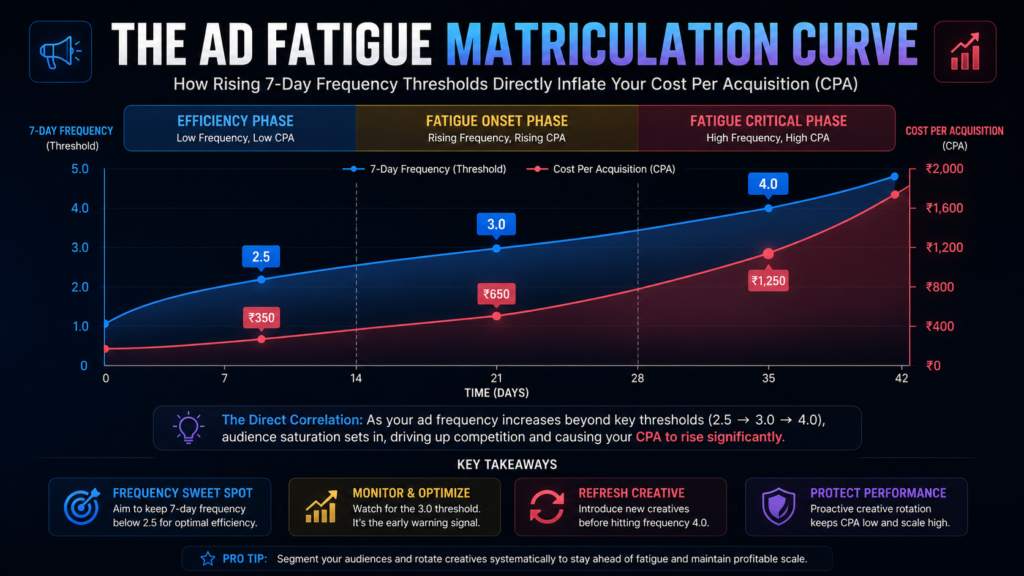
If the frequency climbs to 3.0 or 4.0 without an injection of fresh creative angles, your performance will drop sharply. Your click-through rates will decline because users are actively ignoring your familiar visuals. To combat this, you do not change your audience targeting, you change the visual hook of your ad.
Creative Refresh Velocity: the 30 Percent Rule
Because modern targeting is handled almost entirely by the algorithm, your creative asset is your true targeting lever. The visual imagery, the first three seconds of a video hook, and the primary text select your audience. Therefore, scaling a budget requires a matching acceleration in creative production.
I operate under a strict 30 Percent Rule. If your account is scaling smoothly at a high spend level, 30 percent of your active creative asset weights must be replaced with entirely new concepts or structural iterations every week. You cannot wait for performance to drop before you start editing new videos.
This production line requires a mix of static format structures, founder-led pieces, and high-engagement video assets. To build a highly efficient asset engine that supports this rapid refresh velocity, performance marketers must master rapid generative asset workflows. I cover the full production line in my AI ad creative production workflow, including the brief template and the variant multiplication method.
Budget Distribution Across the Funnel (TOF/MOF/BOF)
The old playbook of setting up a 70/20/10 budget split across Top, Middle, and Bottom of the funnel is dead. Modern data privacy frameworks and cross-platform tracking limits have made granular retargeting ad sets highly inefficient. Small retargeting audiences suffer from high CPMs and severe data loss.
In my scaling architectures, 85 to 90 percent of the total budget is deployed directly into clean, broad Top-of-Funnel (TOF) environments. This includes your ASC campaigns and open broad CBO campaigns. You must let Meta’s algorithm handle the full funnel internally within a single campaign data pool.
When you run a broad campaign with high creative variety, the algorithm naturally serves specific ads to cold prospects, while serving alternative variants to warm prospects who previously interacted with your brand. By consolidating your budget at the top, you give the platform the maximum volume of daily conversion signals required to stabilize your auction costs.
The 5 Most Expensive Mistakes at ₹5L+ Spend
When you scale past ₹5 Lakhs in monthly spend, minor execution errors that were harmless at low budgets suddenly turn into massive financial leaks.
1. Manual Edits That Reset the Learning Phase
Making a major budget change (greater than 20 percent at a time) or editing an active creative asset inside a scaling campaign will instantly push the ad set back into the learning phase. This resets the platform’s optimization data and causes volatile performance fluctuations.
2. Over-Segmenting Audiences by Interest
Splitting your budget across ten different interest groups creates intense internal auction competition. It forces your account to pay a premium to bid against itself, driving up global acquisition costs.
3. Ignoring Post-Click Landing Page Hygiene
Driving high-volume traffic to a slow, unoptimized landing page is the fastest way to burn capital. If your site takes longer than three seconds to load, half of your paid traffic will bounce before the pixel even fires. I cover how to fix these post-click drops in five landing page frameworks that lift D2C and B2B conversion rates.
4. Relying Solely on Standard Browser Pixel Tracking
Relying entirely on standard browser-side pixel tracking leads to massive attribution gaps. Without a clean server-side data stream, Meta cannot match conversion events accurately to its users, causing its machine-learning loops to optimize based on incomplete data.
5. Evaluating Creative Assets Too Quickly
Turning off an ad set after it spends for only 12 hours is a critical mistake. At scale, conversion attribution can experience significant data delays. You must allow an asset to accumulate impressions equal to at least 2 to 3 times your target CPA before making an optimization choice.
Meta Ads Scaling: The Final Framework
Every rule in this guide comes back to one constraint: the delivery system needs enough conversion volume to optimise properly, so protect signal before you chase spend.
Scaling a Meta Ads account sustainably requires discipline, structural simplicity, and a continuous creative pipeline. Stop looking for magical targeting settings or complex combinations of interests. Build a clean, consolidated campaign structure that gives Meta’s machine learning models the room and data they need to optimize effectively.
Focus your energy on refining your unit economics, tracking your overall brand MER, and maintaining a high creative refresh velocity. When your structural foundation is stable and your creative assets are designed to target the right audience segments naturally, scaling up your budget becomes a predictable step-by-step process.
Meta Ads Scaling FAQ
What is the minimum monthly budget needed to use Advantage+ Shopping Campaigns effectively?
While you can technically launch an Advantage+ Shopping Campaign at any budget level, it functions best when it can collect at least 50 conversion events per week. For most brands, this requires a minimum operational budget of ₹1.5 Lakhs to ₹2 Lakhs per month to ensure the algorithm has enough data points to optimize efficiently.
How long should I wait before judging a new Meta Ads campaign’s performance?
You should wait a minimum of 3 to 5 days before making any structural changes to a newly launched campaign. This window allows the platform’s auction dynamics to stabilize and ensures that delayed attribution data can sync completely back to your dashboard.
Should I use Advantage+ Audience or manual interest targeting in 2026?
Advantage+ Audience combined with open targeting parameters should be your primary setup for scaling. Manual interest targeting should be kept strictly within your creative testing campaigns as a temporary guide when you are training a new ad account pixel from scratch.
What is the right ROAS target for a D2C fashion or jewellery brand on Meta Ads?
A sustainable platform ROAS target varies based on your product margins, but most successful D2C brands aim for a steady 2.5 to 3.2 blended ROAS. Do not chase unrealistic metrics, instead, focus on optimizing your average order value (AOV) and lifetime value to protect your net profitability at scale.
How often should creative assets be refreshed at higher spend levels?
At spend levels above ₹5 Lakhs per month, you should introduce fresh creative iterations or new hooks every 7 to 10 days. At higher spend tiers, you must deploy new variants multiple times a week to counteract audience fatigue and rising CPM costs.
Is server-side tracking via Conversions API really necessary?
Yes, implementing server-side tracking via Meta’s Conversions API is an absolute requirement for scaling modern ad accounts. It bypasses browser-side ad blockers, solves data loss issues, and improves your overall event match quality score, which directly reduces your long-term CAC.
About the Author
Akshay Singh Hada is a digital performance marketing manager based in Jaipur, Rajasthan, with 7+ years in paid acquisition and ₹1 CR+ in tracked ad spend across Meta Ads and Google Ads for D2C brands and international B2B. Connect on LinkedIn or request an account audit.
Before you scale, make sure your signal is clean: Meta’s Conversions API guide covers server-side implementation, and the Harvard Business Review marketing section is a useful read on attribution thinking beyond platform dashboards.
Pingback: AI Ad Creative Framework 2026: Generate High-Converting Visuals with AI