
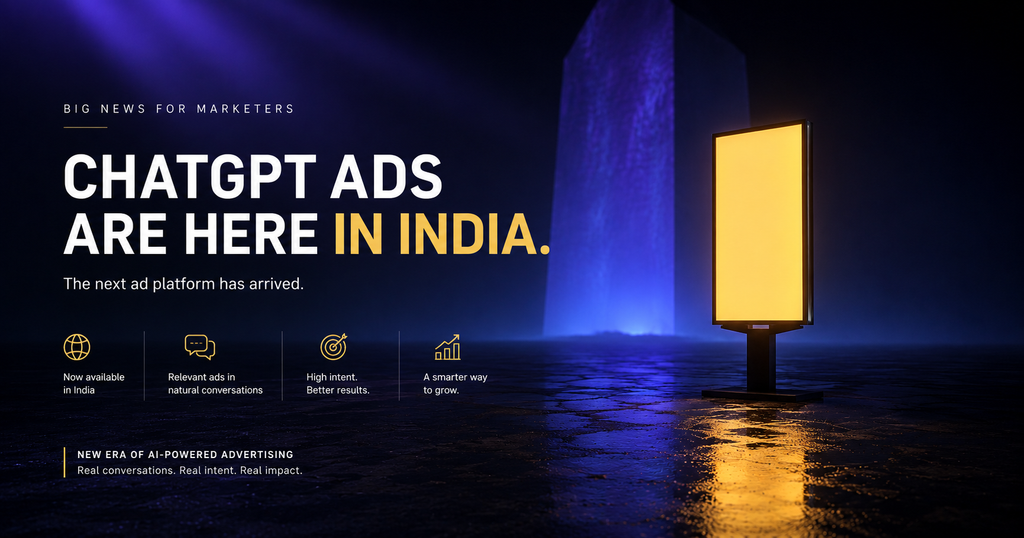
ChatGPT ads went live in India last week, and the self-serve ads manager opens on 4 September 2026 with a minimum daily budget of ₹725. That is two days away, and most of the coverage I have read gets the important part wrong.
The headline everyone is running is the price. The number that actually matters is the placement, and what it tells you about where the real opportunity sits.
What this covers
- What launched, and the exact dates
- What ₹725 a day actually buys
- Where the ads sit, and why it matters most
- What advertisers are actually reporting
- Should you test on 4 September?
- The bigger opportunity nobody is buying
- FAQ
What launched, and the exact dates
OpenAI began showing ChatGPT ads to Indian users on 27 August 2026. They appear for logged-in adults on the free tier and on the ₹399 per month Go plan. Plus, Pro, Business, Enterprise and Education tiers stay ad-free.
The launch went out with more than fifty brands, supported by agencies WPP and Omnicom. As CNBC reported on the India rollout, OpenAI framed advertising as the thing that funds broader access through free and lower-cost tiers.
The dates that matter to you:
- February 2026 — ChatGPT ads first tested with US users
- August 2026 — rollout reaches 38 countries including Japan, South Korea and 31 European nations
- 27 August 2026 — ads go live for Indian free and Go users
- 4 September 2026 — self-serve ads manager opens, minimum ₹725 per day
Two more sources worth reading directly: Business Standard covered the Indian rollout and budget figure, and this report on the launch ahead of OpenAI’s planned 2027 IPO lays out the agency partnerships and country list.
India is OpenAI’s second-largest market. The company disclosed in February that India accounts for more than 100 million of ChatGPT’s weekly active users, which is the entire reason this launch happened here so early.
What ₹725 a day actually buys
Here is where I have to be honest rather than confident, because the honest answer is more useful.
₹725 is a minimum daily budget, not a price. It works out to roughly ₹22,000 a month if you run every day. That is genuinely low as an entry point — comparable to what a small D2C brand already spends testing a single Meta ad set.
What OpenAI has not published is the Indian CPM. And without that number, nobody writing about this launch can tell you what ₹725 buys, including the people currently telling you.
The only public pricing data point
During the US beta, ChatGPT ads were reported as priced around a $60 CPM and sold on impressions rather than clicks. That is a striking model, because it diverges from the performance-based buying that Google Search and Amazon Ads trained everyone on.
If India were priced identically, ₹725 a day would buy you somewhere in the region of 125 impressions. A hundred and twenty-five. That is not a campaign, that is a rounding error.
But India almost certainly is not priced identically. Indian CPMs on every other platform run far below US rates, often by an order of magnitude. If the Indian CPM lands anywhere near local market norms, ₹725 buys meaningful volume rather than a rounding error.
The point is not the arithmetic. The point is that on 4 September you will be asked to commit budget to a channel whose unit economics have not been disclosed. Go in knowing that.

Where the ads sit, and why that matters more than the price
This is the detail buried in paragraph nine of most articles, and it is the whole story.
ChatGPT ads appear below the answer. Not inside it, not beside it. They are clearly labelled as sponsored, visually separated from the response, and OpenAI has stated that answer independence is non-negotiable — advertising does not influence what the model tells the user.
Sit with that for a second, because it changes the entire strategic picture.
When someone asks ChatGPT which jewellery brand to buy from, or which agency to hire, or which CRM to use, the answer they read is the organic one. Your ad is the thing underneath it that they scroll past. You are buying the position that search marketers spent twenty years learning was worth less than the result above it.
The privacy design reinforces this. Advertisers never see conversations, chat history or personal details — only aggregate performance data. Users who state or are predicted to be under 18 are excluded entirely, and free users can opt out of ads in exchange for fewer daily messages.
So the targeting signal available to you is thinner than what you get on Meta, and the placement is subordinate to an organic answer you cannot buy your way into. Both of those are deliberate design choices, and both should shape how much you spend here.
What advertisers are actually reporting
OpenAI’s numbers look excellent. The ads pilot reportedly crossed $100 million in annualised revenue within six weeks of launching. The company projects $2.5 billion in ad revenue for 2026 and $100 billion by 2030, and it has been building the infrastructure to match — an ads manager described as similar in layout to Google Ads, an adtech partnership with Criteo, and a reduction in the pilot participation minimum from $200,000 to $50,000.
Now the part that does not make the press release.
eMarketer’s reporting on the pilot is blunt about advertiser sentiment. Some advertisers described the ad process as relatively low-tech. Agency executives said they had not observed measurable business outcomes. The core complaint was measurement: OpenAI was not providing enough information on how ads perform beyond impressions and clicks, which makes attribution to actual revenue difficult.
That gap is exactly what the new ads manager is meant to close, and it may well close it. But as of today, the honest state of ChatGPT ads is: enormous audience, real spend flowing in, and no public evidence yet of business outcomes at the level advertisers expect from a mature channel.
Anyone telling you on 4 September that this channel is proven is telling you something they cannot know.
Should you test ChatGPT ads on 4 September?
Depends entirely on which of these you are.
Test early if this is you
You sell something people research before buying. Software, financial products, education, travel, high-consideration purchases. ChatGPT is where that research increasingly starts, and being present in that moment has value even if the attribution is fuzzy.
You have budget you can genuinely afford to learn with. ₹22,000 a month to find out how a new channel behaves before your competitors do is a reasonable trade for a brand already spending several lakh a month. It is not reasonable if it is a quarter of your total budget.
You are measuring properly already. If your Meta and Google attribution is clean, you have a fighting chance of seeing whether ChatGPT ads move anything. If your tracking is already broken, adding a channel with thin reporting will teach you nothing.
Wait if this is you
You are still not profitable on Meta or Google. A new channel does not fix a broken funnel. It gives you a second place to lose money, with worse reporting.
You need attributable performance this quarter. The measurement layer is immature by OpenAI’s own advertisers’ account. If you have to defend every rupee to a board, this is not the quarter.
Your product is impulse-priced. Low-ticket, fast-decision categories are already well served by Meta’s delivery system. A sponsored slot beneath an AI answer is a poor substitute for a scroll-stopping Reel.

The bigger opportunity nobody is buying
Go back to the placement detail, because this is the actionable part.
ChatGPT ads sit beneath the answer. The answer itself cannot be bought. It is assembled from what the model has learned and, increasingly, from what it retrieves live from the web at the moment of the question.
Which means the most valuable position in ChatGPT is still free, and it is being contested by almost nobody in India.
Getting cited inside the answer is a content and entity problem, not a media buying problem. It comes from publishing genuinely useful material, structuring it so machines can parse it, and building a consistent entity footprint across the web so the model knows who you are and what you are authoritative about.
I would put it like this. If you have ₹22,000 a month spare and you are choosing between buying the slot below the answer or investing in being inside the answer, the second one compounds and the first one stops the day you stop paying.
That is not an argument against testing ChatGPT ads. Test them. It is an argument against treating the ad slot as the whole opportunity when it is visibly the smaller half of it. If you want the measurement side of this, I wrote separately about how Google now reports on content performance beyond your website, which is the closest thing we currently have to tracking AI-adjacent visibility.
FAQ
When do ChatGPT ads open for self-serve in India?
4 September 2026. The self-serve ads manager opens with a minimum daily budget of ₹725, which is roughly $7.60.
Who sees ChatGPT ads in India?
Logged-in adults on the free tier and the ₹399 per month Go plan. Plus, Pro, Business, Enterprise and Education subscribers do not see ads. Users who state or are predicted to be under 18 are excluded.
Can ChatGPT ads change the answer I get?
OpenAI says no. Ads appear below the response, are clearly labelled as sponsored, and the company has stated that answer independence is non-negotiable.
What data do advertisers get from ChatGPT ads?
Aggregate performance data only. Advertisers do not see conversations, chat history or personal details. Advertisers in the earlier pilot reported that reporting beyond impressions and clicks was limited, which is a fair thing to expect at this stage.
How much do ChatGPT ads cost in India?
The published figure is the ₹725 minimum daily budget. OpenAI has not disclosed Indian CPM rates. The only public CPM figure comes from the US beta, which was reported around $60 on an impressions basis, and there is no reason to assume Indian pricing matches it.
Are ChatGPT ads worth it for small businesses?
At ₹22,000 a month the entry cost is low, but the measurement is immature. For a small business that needs every rupee attributable this quarter, waiting a cycle is defensible. For a business that can afford to learn a channel early, the low minimum makes it an unusually cheap experiment.
The takeaway
ChatGPT ads in India are a genuinely significant launch, and ₹725 a day is a genuinely low door to walk through. On 4 September a lot of Indian brands will walk through it, and some of them will find something useful.
Just be clear about what you bought. You bought the space beneath the answer, in a channel whose Indian unit economics have not been published and whose own pilot advertisers say they cannot yet prove outcomes.
Test it with money you can afford to learn with. Keep measuring properly. And spend at least as much attention on being inside the answer as you do on buying the slot below it.
I have managed ₹1 CR+ in tracked ad spend across Meta and Google Ads, building acquisition systems for D2C and B2B brands. More frameworks on the blog. If you want help deciding where a new channel fits in your mix, get in touch, or read more about how I work.