
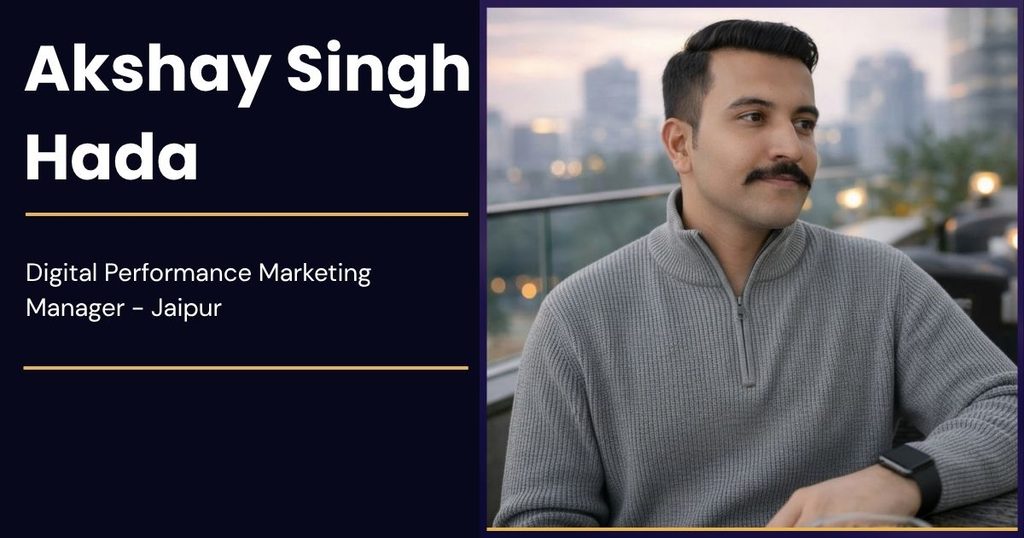
Akshay Singh Hada is a digital performance marketing manager based in Jaipur, Rajasthan, India. He has over seven years of experience running paid acquisition on Meta and Google Ads, with more than ₹1 crore in tracked ad spend managed across D2C and B2B accounts.
This page is the full picture: background, what he actually works on, the method he uses on every account, published frameworks, and where to find him across the web. If you landed here after searching his name, this answers the question directly rather than making you piece it together from a LinkedIn headline.
On this page
- Who is Akshay Singh Hada?
- Background and education
- What he works on
- The method behind every account
- Published frameworks and writing
- Where to find Akshay Singh Hada online
- How to work together
- Frequently asked questions
Who is Akshay Singh Hada?
Akshay Singh Hada is a performance marketing manager who specialises in paid acquisition for direct-to-consumer and business-to-business brands. He works from Jaipur, Rajasthan, and handles both Indian D2C campaigns and international B2B lead generation across the United States, United Kingdom, Australia and the European Union.
His core platforms are Meta Ads and Google Ads. Alongside those, he builds AI-assisted workflows that handle the reporting and auditing layer of campaign management, which is the part of the job that traditionally eats the most hours and produces the least thinking.
The short version: he plans, builds and scales paid campaigns, and documents the frameworks publicly so other marketers can use them.
Quick facts
- Full name: Akshay Singh Hada
- Also known as: Akshay Hada, Akshay Singh
- Role: Digital Performance Marketing Manager
- Based in: Jaipur, Rajasthan, India
- Originally from: Kota, Rajasthan
- Experience: 7+ years in digital marketing
- Specialisms: Meta Ads, Google Ads, D2C growth, B2B lead generation, CRO, marketing automation
- Education: B.Tech in Electronics and Communication Engineering, JECRC College, Jaipur
- Languages: English, Hindi
Background and education
Akshay Singh Hada grew up in Kota, Rajasthan, and moved to Jaipur for his degree. He studied Electronics and Communication Engineering at JECRC College, Jaipur, graduating in 2019 after a four-year programme.
An engineering background is not the usual route into performance marketing, and it shows in how he approaches accounts. The instinct is to look for the system rather than the tactic — to ask what the delivery algorithm is actually optimising for before deciding what to change. Most of the frameworks on this site come from that habit.
He has since built a career entirely inside paid media, moving from execution into campaign strategy and now into leading acquisition for brands at a manager level. Today he works with a fine jewellery manufacturing house in Jaipur, leading a consumer brand launch in India while running international B2B acquisition for the manufacturing side of the business.
What Akshay Singh Hada works on
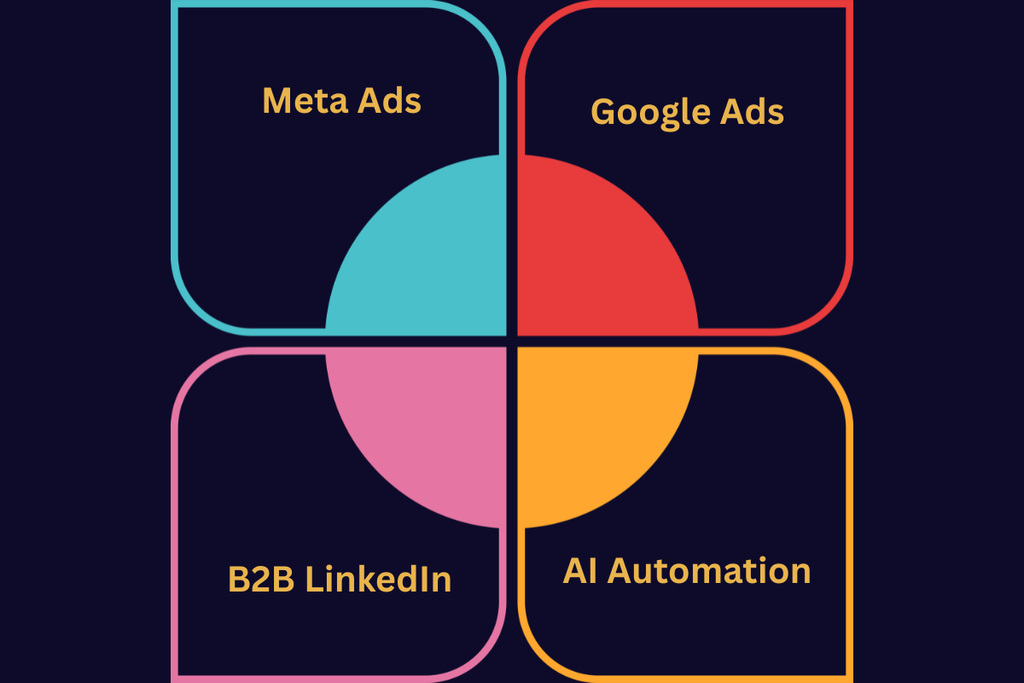
Four areas, and they overlap more than the labels suggest.
Meta Ads for D2C brands
Advantage+ campaign architecture, creative testing cadence, audience fatigue management and the budget rules that let spend scale without breaking return. This is where the bulk of the ₹1 CR+ figure sits.
The work is less about clever targeting than most people expect. Since Meta’s delivery system began reading creative content directly to decide which ad reaches which person, creative variety has effectively become the targeting layer. Building genuinely different concepts, rather than forty colour variants of one static, is now the highest-leverage thing a media buyer does.
Google Ads, Performance Max and Shopping
Search, Shopping and Performance Max architecture built for profitable demand capture. Feed quality, query-level control, negative keyword hygiene and the landing page work that decides whether a click has any chance of converting.
International B2B lead generation
LinkedIn Ads pipelines aimed at wholesale and enterprise buyers across the US, UK, Australia and the EU. B2B in export categories is a different discipline from D2C: longer cycles, smaller audiences, higher costs per lead, and a much heavier dependence on getting the ideal customer profile right before spending anything.
AI-assisted marketing systems
Automation and AI workflows that handle account auditing, reporting and diagnosis. Not to replace judgement, but to remove the hours spent assembling the data that judgement runs on.
The position Akshay Singh Hada takes on this is deliberately unfashionable: AI is genuinely excellent at retrieval, organisation and pattern-finding across structured data, and genuinely poor at the first creative idea that actually matters. Automate the first category, protect the second.
The method behind every account
Same three steps whether the budget is ₹2 lakh or ₹40 lakh a month.
1. Audit before touching anything
Tracking health first: Pixel and Conversions API status, event match quality, deduplication, server-side share. Then account structure, then creative diversity.
A large share of accounts arrive with a signal problem that has been misdiagnosed as a creative problem for months. Fixing structure on top of broken measurement is decorating a house with no foundation, and it is the single most common reason a competent media buyer gets blamed for a result that was never theirs.
2. Build the foundation properly
Clean campaign architecture, correct conversion signal, a creative testing cadence that produces distinct concepts rather than variants, and reporting that assembles itself.
3. Scale against rules written in advance
Budget increases in controlled steps rather than doubles. Review against blended return rather than in-platform ROAS alone. Kill rules defined before the campaign launches, not at 11pm while staring at a red number.
Rules decided calmly in advance beat judgement made under pressure. That is most of what separates accounts that scale from accounts that spike and collapse.
Published frameworks and writing
Akshay Singh Hada writes about the work rather than about marketing in the abstract. Every framework published here comes from an account that was actually running, and the limitations are documented alongside the wins.
Recent pieces cover measurement, paid social delivery systems, Google Ads migrations and AI-assisted auditing:
- Google Search Console platform properties — how Search Console now reports on Instagram, TikTok, X and YouTube performance inside Google.
- Meta Ads MCP and Andromeda — how Meta’s retrieval engine changed what creative diversity actually means.
- Google Ads AI Max migration — the September 2026 auto-upgrade and the seven steps to take before it.
- Instagram content audit with Claude — the AI workflow that replaces a day of manual social reporting.
The full archive sits on the blog, updated as new platform changes land.
Where to find Akshay Singh Hada online
Same name, same photograph, same description everywhere. Consistency across profiles is how search engines and AI systems confirm that all of these accounts belong to one person rather than several.
- LinkedIn — professional profile and campaign updates
- Medium — long-form marketing writing
- Freelancer — independent project profile
- About.me — short professional summary
- Website — akshaysinghhada.com, the primary source for everything above
If you find an account using this name that is not listed here, it is not connected to Akshay Singh Hada.

How to work with Akshay Singh Hada
The brands that get the most out of this are usually in one of three situations.
Spend is scaling and return is slipping. The account worked at one budget and stopped working at three times that budget. This is nearly always a structure and signal problem rather than a creative problem, and it is diagnosable within a day.
A D2C brand is launching in India. The first ninety days set the measurement foundation that everything afterwards depends on. Getting tracking, structure and creative cadence right at launch is dramatically cheaper than retrofitting it in month eight.
An exporter needs international B2B pipeline. Manufacturing and wholesale businesses selling into the US, UK, Australia or the EU, where LinkedIn is the realistic channel and the ideal customer profile matters more than the ad.
If one of those describes your situation, the contact page is the fastest route. Audits start with a look at tracking, because there is no point discussing creative until the measurement can be trusted.
The point of view
Four positions Akshay Singh Hada holds that shape how every account gets run. They are worth stating plainly because they are not universally shared, and a client should know what they are hiring before they hire it.
Measurement comes before creative, always
An account with broken conversion tracking cannot be diagnosed, only guessed at. Every optimisation decision runs on the conversion data, and every automated bidding strategy runs on it harder still. Fixing signal is unglamorous work that nobody puts in a case study, and it is the highest-return hour available on most accounts.
This is why the first conversation is always about tracking rather than about ads. Clients occasionally find that anticlimactic. It is also why the second month usually looks very different from the first.
Creative variety beats creative volume
Meta’s delivery system now reads the content of an ad and matches it to individual users. That means forty variations of the same static image give the algorithm roughly one option repeated forty times, while six genuinely different concepts give it six different doors into six different audiences.
Most brands producing “more creative” are producing more of the same thing. The distinction between variation and concept is the difference between a creative budget that compounds and one that evaporates.
AI handles retrieval, humans handle judgement
Akshay Singh Hada runs most reporting and auditing through AI workflows, and publishes the prompts openly. He also draws a hard line: AI does not make the creative decision, does not choose the offer, and does not execute anything irreversible on live spend without review.
As generation gets cheaper, the ability to recognise whether something is any good becomes more valuable, not less. That recognition is the job now.
Publish the failures too
Every framework published on this site includes what it cannot do. The Instagram audit workflow cannot see images. The Meta connector cannot see creative assets. Google’s headline performance claims measure something narrower than most people assume.
Marketing writing that only publishes wins is useless to anybody trying to actually learn the job, and it is usually a sign the author has not run the thing they are describing.
Platforms and tools
The working stack Akshay Singh Hada uses day to day, grouped by what each part actually does.
- Paid media: Meta Ads Manager, Google Ads, LinkedIn Campaign Manager
- Measurement: Meta Pixel and Conversions API, Google Analytics 4, Google Tag Manager, Google Search Console
- Retention: email marketing platforms and WhatsApp Business messaging flows
- Creative: Canva, AI image generation, structured creative brief systems
- Automation: n8n workflow automation and AI assistants connected through the Model Context Protocol
- Site and SEO: WordPress, Rank Math, structured data implementation
Tools change. The method does not. A media buyer who understands why a delivery system behaves the way it does can pick up a new platform in a fortnight; one who has only memorised where the buttons are cannot.
Results and proof
Some honesty about numbers, because this is where most personal marketing pages become unreadable.
The ₹1 crore-plus figure refers to cumulative tracked ad spend managed across accounts over several years, not a single campaign and not a single month. Ad spend managed is a scale metric. It says something about the size of problems handled; it says nothing on its own about profitability, and any marketer presenting it as a result rather than as context is doing you a disservice.
Specific client outcomes are governed by confidentiality. Where campaign detail appears in the writing on this site, it is anonymised by category rather than named, and figures are given as ranges rather than exact revenue. That is a deliberate choice, and it is worth asking any consultant why their case studies are not.
The verifiable proof is the published work. The frameworks on this site name real platform mechanics, real dates and real limitations, which is a harder thing to fake than a screenshot of a dashboard.
Why Jaipur matters to the work
Being based in Jaipur rather than Mumbai, Bangalore or Delhi is not incidental to how Akshay Singh Hada works, and it comes up often enough to be worth addressing.
Rajasthan is the centre of India’s jewellery manufacturing and export industry. A significant share of the fine and demi-fine jewellery sold internationally passes through Jaipur workshops. That means the D2C and B2B problems handled here are not generic ecommerce problems — they involve long production cycles, high average order values, seasonal demand tied to wedding calendars, and international wholesale buyers with procurement processes measured in months rather than days.
Marketers who have only run fast-moving low-ticket ecommerce tend to underestimate how differently a high-consideration category behaves. Creative that works for a ₹599 impulse purchase does not work for a ₹40,000 considered one, and the measurement window that looks correct for the first is misleading for the second.
There is also a straightforward practical point. Operating from Jaipur means a lower cost base than a metro agency carrying metro overheads, without any difference in platform access or capability. The Meta and Google interfaces are identical everywhere; only the invoice changes.
What working together actually looks like
Three things clients consistently say they were not expecting.
The first two weeks look slow. Auditing tracking and rebuilding structure produces no visible dashboard improvement while it is happening. Accounts that are rushed past this stage tend to spend the following six months debugging a problem that was visible on day one.
Reporting is shorter than expected. A weekly report should be three findings and a decision, not forty screenshots. If a report cannot be read in four minutes, it is not being read at all.
Bad news arrives early. A campaign that is not working gets flagged in week one rather than defended until the monthly review. Akshay Singh Hada would rather deliver an uncomfortable update quickly than a comfortable one late, because only one of those leaves enough budget to fix the problem.
Frequently asked questions
Who is Akshay Singh Hada?
Akshay Singh Hada is a digital performance marketing manager based in Jaipur, Rajasthan, India. He specialises in Meta Ads and Google Ads for D2C brands and international B2B lead generation, with over seven years of experience and more than ₹1 crore in tracked ad spend managed.
Where is Akshay Singh Hada based?
Jaipur, Rajasthan, India. He originally comes from Kota, Rajasthan, and works with clients across India as well as international B2B markets.
What does Akshay Singh Hada specialise in?
Paid acquisition. Specifically Meta Ads, Google Ads including Performance Max and Shopping, LinkedIn Ads for B2B, conversion rate optimisation, and AI-assisted marketing automation.
What is Akshay Singh Hada’s educational background?
A B.Tech in Electronics and Communication Engineering from JECRC College, Jaipur, completed in 2019.
How much ad spend has Akshay Singh Hada managed?
More than ₹1 crore in tracked ad spend across Meta and Google Ads, spanning D2C ecommerce and international B2B accounts.
Is Akshay Singh Hada available for freelance or consulting work?
Enquiries go through the contact page. The best fit is usually a brand scaling spend, a D2C launch in its first ninety days, or an exporter building international B2B pipeline.
What is the difference between Akshay Singh Hada and Akshay Hada?
Same person. Akshay Hada and Akshay Singh are both shortened forms of the full name, and all profiles listed on this page belong to the same individual.
In one line
Akshay Singh Hada builds paid acquisition systems that scale profitably, documents the frameworks publicly, and is honest about the parts that do not work. That last bit is deliberate: most marketing writing only publishes the wins, which makes it useless to anybody trying to learn the job.
The frameworks are on the blog. The enquiries go through the contact page. Everything else is on LinkedIn.