
Key Takeaways
- ROAS is now a delivery metric, not a decision metric. In a January 2026 survey of 500 senior decision-makers, independent incrementality testing was trusted by 60%, against 37% for in-platform reporting.
- Meta reclassified click-through attribution on 3 March 2026 to count link clicks only — every pre-March ROAS benchmark in your deck is now a different metric.
- Google auto-migrated broad match and auto-created-asset Search campaigns to AI Max in September 2026. Dynamic Search Ads follow in February 2027.
- Real account data below: CPM fell 64% while CPA rose 53%. Cheaper impressions bought worse customers — and ROAS alone never showed it.
- Performance marketing in 2027 runs on triangulation: platform attribution for daily calls, incrementality quarterly, MMM semi-annually.
Performance marketing in 2027 has a measurement problem, not a media problem. The platforms got significantly better at spending your money and significantly worse at telling you what it actually bought. Meta reclassified click-through attribution in March 2026. Google is force-migrating Dynamic Search Ads into AI Max by February 2027. Only about one in five marketers still believes last-click reflects a platform’s real business impact.
ROAS did not stop working. It stopped being the whole answer. Performance marketing in 2027 still needs the number — just not as the headline your budget hangs on. This guide covers what actually changed, what the numbers look like inside a live account, and the measurement stack that holds up when your CFO asks a harder question than “what’s the ROAS?”
Why ROAS Quietly Broke in 2026
Three things happened in the same twelve months, and together they changed what the number on your dashboard means — and what performance marketing in 2027 actually has to measure.
1. Meta changed what a conversion counts as
On 3 March 2026, Meta announced that click-through attribution for website and in-store conversions counts link clicks only. Sounds like a footnote. It isn’t — your Q4 2025 ROAS and your Q2 2026 ROAS now measure subtly different populations. Benchmark against pre-March numbers in a board deck and you are comparing two metrics and calling it a trend.
2. The manual lever came off
Advantage+ is now the default for Sales, App and Leads. You no longer choose “manual” or “automated” at setup — you start with automation on and decide what to switch off. Advantage+ Shopping became Advantage+ Sales, ad sets came back without a fixed limit at 50 ads each, and the existing-customer budget cap was removed. Want that new-vs-returning split? You rebuild it yourself with ad sets and exclusions.
Google moved the same direction. Search campaigns using campaign-level broad match or standalone automatically created assets were auto-upgraded to AI Max between 1 and 30 September 2026 — whether or not anyone logged in that month. Manual language targeting disappeared from Search. Automated promotions switched on by default in October.
3. Finance stopped believing the dashboard
This is the one that matters for your job. Platform-reported conversions routinely diverge from site-side analytics and from actual sales, and finance teams noticed. The structural problem: attributed ROAS over-credits the channels that harvest existing intent and under-credits the ones that generate it. Allocate on it long enough and you quietly defund the top of your own funnel, then wonder why the bottom dried up.
The trust gap, in numbers
Asked which measurement method they trust most, 500 senior US decision-makers ranked independent incrementality testing first at 60%, marketing mix modelling second at 40%, and in-platform reporting last at 37%. Separately, 46.9% of marketers planned to increase MMM investment over the following year, and just 21.5% still believed last-click reasonably reflects a platform’s long-term business impact.
What Performance Marketing in 2027 Looks Like Inside a Real Account
Theory is cheap. Here is what performance marketing in 2027 looks like over 90 days in a fine-jewellery D2C account I run paid media for in India. Figures are real and pulled directly from the ad account; brand and campaign identifiers are removed.
A 2.22x blended ROAS on a jewellery account is unremarkable. Not a disaster, not a win. If that is the only number on your weekly report, you file it and move on. Now split it by month.
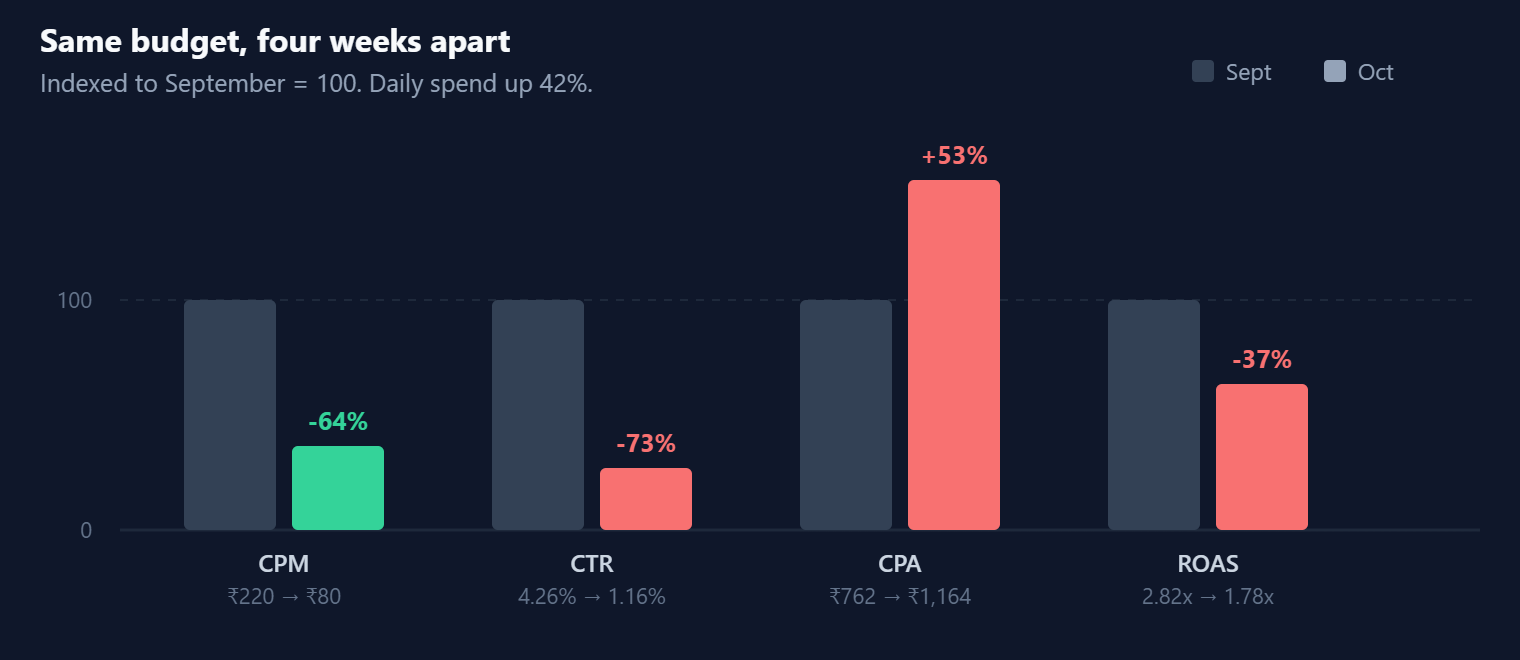
Read that again, because it is the entire argument of this guide in one chart. CPM dropped 64%. Impressions per day went up roughly four times. And every single thing that matters got worse. Daily spend rose 42%, daily purchases fell 7%, cost per purchase climbed from ₹762 to ₹1,164, and ROAS fell from 2.82x to 1.78x.
Average order value barely moved — ₹2,145 to ₹2,067 — so this is not discounting or product mix. The algorithm found cheaper inventory and spent there. Cheaper inventory meant colder, less-qualified people. Frequency fell from 2.82 to 1.79: reach got broader and shallower.
The leak ROAS will never show you
Now map the same 90 days as a funnel instead of a ratio.
3,675 people put jewellery in a cart. 370 started checkout. That is a 90% drop at one step, and it is worth roughly as much as the entire media budget. Once someone reaches checkout the account closes them at 52% — the back end is fine. The breakage is in between.
Be honest about what this could be: either a genuinely broken cart-to-checkout experience, or an InitiateCheckout event that is not firing reliably. Opposite diagnoses, opposite fixes. ROAS cannot tell you which, because it is a ratio of two numbers that both sit at the very end of the funnel. You only see this by instrumenting every step — which is what the Meta Conversions API exists for.
Meta Advantage+ in 2027: What You Still Control
In performance marketing in 2027 the question is no longer whether to use Advantage+. It is which parts to switch off, and for which objective. Your real levers now:
- Creative volume and variety. With targeting abstracted away, creative is your targeting. Ad sets hold up to 50 ads — use them properly instead of four variants of the same shot. My AI ad creative framework covers producing that volume without the output turning into slop.
- Signal quality. Pixel plus Conversions API, deduplicated, clean event parameters. Value Optimization and pLTV bidding stabilise at roughly 30–50 high-value purchase events a week; standard delivery still wants about 50 weekly. Below that, the model learns from noise.
- Exclusions, not restrictions. Steer the system away from waste with exclusions. Narrow targeting now actively hurts — it blocks the algorithm from finding segments you never thought of.
- Offer and landing experience. The only part of the funnel the platform does not touch — and, as the chart above shows, usually where the money is lost.
Google PMax and AI Max: The February 2027 Deadline
Google’s 2027 calendar has a hard date on it. Dynamic Search Ads are scheduled to migrate into AI Max between 1 and 28 February 2027. Search campaigns still running Display Expansion move to channel prioritisation in the same window. If you have legacy DSA campaigns carrying real volume, that migration is a Q1 2027 project, not a Q4 2027 surprise.
The upside: Performance Max gave real control back in 2026. Negative keywords now work at campaign and account level, which finally stops PMax eating the brand traffic your brand Search campaign converts far more cheaply. Search term visibility improved. Channel prioritisation caps Search partners and Display separately, though Google’s own surfaces stay bundled — you cannot cap YouTube against Search.
Do this before February 2027
1. Record each DSA campaign’s current CPA baseline now, while you still have a clean pre-migration comparison.
2. Add account-level brand negatives so PMax stops cannibalising brand Search.
3. Check channel prioritisation tiers — every channel starts at High by default.
4. Turn off automated promotions if your offer calendar is managed manually; on by default since 12 October 2026.
One honest caveat for any AI Max rollout: independent testing has been mixed. Google reports solid conversion uplift for campaigns moving off exact and phrase match, but a substantial share of advertisers saw neutral or negative outcomes when measured at account level rather than campaign level. Migrate deliberately and hold a control. Note too that Google’s 2026 announcements include Demand Gen uplift experiments and Meridian-powered budgeting that blends MMM, attribution and incrementality tests. When a platform ships its own incrementality tooling, that tells you how much faith to put in its attributed ROAS.
B2B PPC in 2027: Your Window Is Lying to You
Everything above gets worse in B2B, because in performance marketing in 2027 the measurement window and the sales cycle are not even in the same order of magnitude.
The 2026 benchmark data is blunt about it. The average B2B buyer journey now runs 272 days, up from 211, across roughly 88 touchpoints and a buying committee of about ten people. A 30-day attribution window returns somewhere around 0.1–0.3x on LinkedIn, climbing to 1.5–3.0x by 180 days. If you judge a B2B channel on a 30-day window, you will kill it at exactly the moment it starts working.
| Channel | Reported ROAS | Typical CPC | Best used for |
|---|---|---|---|
| LinkedIn Ads | 121% | $5.26–$8.50 | ABM, enterprise, committee reach |
| Google Search | 67% | ~$2.69 | High-intent capture |
| Meta Ads | 51% | Low | Volume lead gen, awareness |
LinkedIn was the only major platform delivering positive B2B ROAS at scale in the 2026 benchmarks, and now takes around 41% of B2B paid social budgets. The assist effect matters more than the direct number: ICP accounts converted roughly 46% better in paid search after seeing LinkedIn ads, and SDR meeting-to-deal conversion rose about 43%. None of that shows up in LinkedIn’s own ROAS column.
So in performance marketing in 2027, stop reporting CPL. Report cost per sales-accepted lead and cost per opportunity. CPL optimises for form fills; your pipeline does not run on form fills.
The Measurement Stack That Replaces ROAS
The industry settled on a word for this in 2026, and it is the backbone of performance marketing in 2027: triangulation. Three methods, three different questions, no single one load-bearing.
| Layer | Question it answers | Cadence | Use it for |
|---|---|---|---|
| Platform attribution | What happened, and in which campaign? | Daily | Creative calls, budget shifts within a channel |
| Incrementality testing | Would this sale have happened anyway? | Quarterly | Validating whether attribution is causal |
| Marketing mix modelling | How should the whole portfolio be split? | Semi-annually | Cross-channel allocation, offline channels |
Only incrementality is causal. It withholds advertising from a randomly selected group and compares the outcome against an exposed group — the one method that answers whether the ad caused the sale. MMM is correlational and can overstate a channel by multiples. Attribution describes; it does not prove.
The practical application is a correction factor. If Meta reports 3.2x and your lift test says true incremental impact is 1.8x, your ratio is about 0.56 — apply it to bid targets and break-even maths instead of arguing with the dashboard. Test the channels where reported ROAS is highest and your confidence is strongest; that is where the correction is usually largest.
The 2027 Dashboard: What Actually Goes on It
Replace the ROAS-first weekly report with the performance marketing in 2027 version. Six metrics, in this order.
- Blended CAC — total marketing spend divided by total new customers. No attribution assumptions, impossible to game.
- Contribution margin after ad spend — revenue minus COGS, shipping, payment fees, returns and media. This is the number that decides whether you scale.
- New-customer share — what percentage of purchases came from first-time buyers. With the Advantage+ existing-customer cap gone, this is the only way to know whether you are buying growth or re-buying your own list.
- Incrementality-corrected ROAS — platform ROAS multiplied by your most recent lift factor.
- Funnel step conversion rates — click → landing page view → cart → checkout → purchase. The chart above is why.
- Creative refresh rate — new concepts shipped per week. In an automated buying environment this is your highest-leverage input.
Platform ROAS still belongs on the report. It belongs at number seven, as a delivery diagnostic — not as the headline your budget decisions hang on. For the campaign-level mechanics of scaling once this measurement layer is in place, see my Meta Ads scaling guide.
Frequently Asked Questions
Is ROAS still a useful metric in 2027?
Yes. In performance marketing in 2027 it still earns its place for tactical decisions inside a single channel — which creative to kill, which ad set to scale. It stops being useful the moment you use it to compare channels or set total budget, because attribution over-credits intent-harvesting channels and under-credits demand-generating ones. Use it daily, never as the basis for strategic allocation.
What changed with Meta attribution in March 2026?
Meta announced on 3 March 2026 that click-through attribution for website and in-store conversions counts link clicks only. The practical effect is that performance data before and after that date is not directly comparable, so any year-on-year ROAS trend spanning March 2026 needs a footnote.
Do I have to move my Search campaigns to AI Max?
Partly, already. Campaigns using campaign-level broad match or standalone automatically created assets were auto-upgraded between 1 and 30 September 2026, and Dynamic Search Ads are scheduled to migrate between 1 and 28 February 2027. Migrated campaigns can still turn AI Max off. Other Search campaigns remain opt-in for now, but the direction of travel is clear.
How big does an incrementality test need to be?
It depends on your baseline conversion volume and the lift you need to detect — smaller expected lifts need far more data. Practical rule: run geo holdouts on your highest-spend channel first, give it a full purchase cycle rather than two weeks, and accept that a test too small to reach significance is worse than no test, because it produces a number people quote anyway.
What should a small D2C brand do if it cannot afford MMM?
Skip MMM entirely and run two things: blended CAC tracked weekly against contribution margin, and a simple geo holdout once a quarter. That combination catches most of what MMM would catch at a fraction of the cost. MMM earns its keep when you have several channels, meaningful offline spend, and enough spend history for the model to separate them.
Why did my CPM drop but my results get worse?
Because CPM measures the price of attention, not its quality. When automated delivery finds cheaper inventory it is usually finding colder, less-qualified audiences. The account in this guide saw CPM fall 64% while cost per purchase rose 53% in the same period. Treat a sudden CPM drop as a warning to check CTR and CPA, not as a win.
The Short Version
Performance marketing in 2027 rewards people who can tell the difference between spending efficiently and growing a business. The platforms handle the first part better than you can. The second — knowing which spend caused incremental revenue, and where the funnel is leaking — is the job that is left. Start your performance marketing in 2027 there this week: instrument every funnel step and look at the drop-offs. The 90% cart-to-checkout leak above sat invisible on a ROAS report for months. Yours probably has one too.